Protecting Your Rights: Serving West Anchorage | | Tri-partisanship in the Legislature | | Sen. President Gary Stevens (R-Kodiak), Senator Loki Tobin (D-Anchorage), and Representative Alyse Galvin (I-Anchorage) | | |
Alaska's Legislature is unique because both our House and Senate are controlled by bi- and tri-partisan majorities. In the Senate, we have a majority coalition of nine Democrats and five Republicans. The House of Representatives is controlled by a majority coalition of fourteen Democrats, four nonpartisans, two Republicans, and one independent.
These bi- and tri-partisan majorities are based on cooperation, civility, and finding areas of shared agreement. In recent years, shared priorities have included balancing our state budget, increasing education funding, and finding solutions to the gas shortage.
The Council of State Governments recently spoke with three members of Alaska’s coalitions, each hailing from different political parties, to learn more about the move and how they’ve gone about fostering a spirit of civility and cooperation. They conducted the interviews individually, and participants’ remarks have been edited for length and clarity.
| |
Improving the Balancing of Power:
Senate Joint Resolution 2
| | |
Article II, Section 17 of Alaska's Constitution states:
"Upon receipt of a veto message during a regular session of the legislature, the legislature shall meet immediately in joint session and reconsider passage of the vetoed bill or item. Bills to raise revenue and appropriation bills or items, although vetoed, become law by affirmative vote of three-fourths of the membership of the legislature. Other vetoed bills become law by affirmative vote of two-thirds of the membership of the legislature."
According to Alaska’s Constitution: A Citizen’s Guide, published by the Legislative Affairs Agency, “[f]ew other states make the distinction between a bill dealing with substantive law and an appropriation bill.” Alaska is the only state that has a three-fourths requirement to override the Governor’s veto on appropriation matters like the annual state budget. The other 49 states have lower override standards.
Why did Alaska's constitutional convention delegates choose to construct this unusual system for overriding a revenue or appropriations veto?
Alaska's framers wanted a system with a strong executive branch. According to delegate Vic Fischer, this approach was partly in response to the territorial system of government, which had a "highly diffused" executive branch. In his 1975 book Alaska's Constitutional Convention, he states:
"In this situation, government was neither responsible nor responsive to the people. As a result, convention delegates were ready to make basic structural changes so the people could hold the governor wholly responsible for the conduct of state administration. In balance with a strong legislature and independent judiciary, there was little concern about creating too strong an executive." (University of Alaska Press 1975, p. 105-106.)
Senate Joint Resolution 2 proposes an amendment to the Constitution of the State of Alaska. If SJR 2 passes the Legislature, it will put the resolution on the ballot for all registered Alaskan voters to consider in the 2026 general election. If placed on the ballot by this resolution and approved by the voters, it would change the requirement to override a veto on revenue and appropriation bills from three-fourths of the Legislature to two-thirds of the Legislature in joint session.
|
Department of Agriculture and Education Funding Task Force Updates
When the Governor called a special session in early August, he called for consideration of two items: an Executive Order creating a Department of Agriculture and education funding.
The Legislature overrode the Governor's veto of education funding and restored over $50 million for public schools. And last month, the Task Force on Education Funding met for the first time to begin studying long-term solutions for Alaska's schools.
During special session, however, the Legislature did not consider the Governor's Executive Order to create a Department of Agriculture. That's because the Alaska Constitution requires that executive orders receive 60 days of consideration in a regular session (or the full duration of a regular session, if of shorter duration). That period of consideration isn't possible in a short, special session. What's more, the Executive Order that the Governor released is substantially similar to an earlier Executive Order the Legislature rejected in March of this year. There is no precedent for releasing multiple identical executive orders. For both of these reasons, the August Executive Order was likely illegal and unconstitutional.
On the first day of the Special Session, Senate President Stevens and House Speaker Edgmon sent the Governor's office a letter explaining these reasons. You can read that letter here.
| | → Suicide Prevention Month & Alaska Youth Suicide Prevention Summit | | |
September is National Suicide Prevention Month. With Alaska leading our nation in suicide rates, we need to take preventative measures seriously.
In 2023, I wrote an op-ed in the Anchorage Daily News about my own experience helping a friend in distress. This month, take the time to learn about the warning signs of suicide, how to support someone who may be struggling, and resources available for those in need.
| | |
In collaboration, the Department of Health, Division of Behavioral Health, Statewide Suicide Prevention Council, and the Alaska Mental Health Trust Authority are hosting the Alaska Youth Suicide Prevention Summit on Friday, September 12.
Alaska’s youth are invited to attend an engaging, interactive event focused on protective factors and the role they play in building strong mental health. The goal of this free summit is to provide young Alaskans with tools they can use to help them deal with the extreme highs and lows that everyone experiences in life. Designed for ages 13-19*, participants will enjoy a day of activities that will help them learn about themselves and their peers, including how to channel impulsivity toward safe outlets for emotional health and how to cultivate and maintain mental well-being.
Registration is free and open until the day of the event.
*Disclaimer: Parent or guardian permission required for attendees under 18. Participants 14 and under must be accompanied by an adult.
| | → Transit on the Move Community Survey | |
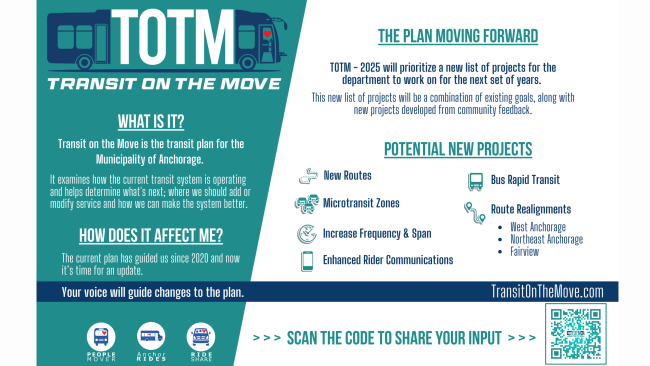
Transit on the Move (TOTM) is the transit plan for the Municipality of Anchorage. The Municipality will update the plan every three to five years. This plan examines how the current transit system is operating and helps determine what's next; where should we add or modify service; and how we can make the system better. Discussions for the 2020 plan led to a list of future system adjustments ranked by priority.
This plan looks at shared opportunities for all three services:
PEOPLE MOVER - Fixed Route Bus Service
ANCHORRIDES - Paratransit Service
RIDESHARE - Vanpool
Each service operates independently, while working together to provide valuable public transportation options within the Municipality.
Please click here to visit the Municipality's TOTM webpage and please click here to view the TOTM 2020 Transit Plan.
Please take a moment to provide your input on public transportation in Anchorage.
| | |
Municipality of Anchorage's 50th Anniversary
Residents of the City of Anchorage and the Greater Anchorage Area Borough voted to unite in 1975, becoming the Municipality of Anchorage (MOA). 2025 is the MOA's 50th Anniversary.
Below are a few highlights of events going on this month in celebration of the MOA's 50th anniversary. To view the full list and for more information, please click here to visit the MOA's website.
| | |
Taste of Spenard
When: Sunday, September 14th from 12:00 to 5:00 PM
Where: Spenard Rd & W 26th Ave. Click here for more information.
Taste of Spenard will start at noon in the Chilkoot Charlie’s parking lot with live music, food trucks, farmers and wellness market vendors, and a beer garden provided by Koot's!
| | |
CONTACT INFORMATION
(907) 269-0130
Sen.Matt.Claman@akleg.gov
Anchorage Legislative Information Office, Rm 321
Anchorage, Alaska 99503
https://www.alaskasenate.org/matt-claman/
| |
CONTACT THE GOVERNOR
(907) 465-3500
550 West 7th Ave. Suite 1700
Anchorage, Alaska 99501
STATE OF ALASKA
State Info: (907) 269-5111
| |
CONTACT THE ADN
Write a Letter to the Editor
Submit your letter to the Anchorage Daily News via email or web form.
attn: Letters to the Editor
| | | | |