Senate Majority Bipartisan Coalition Website

State Senator District E

Senate Majority Leader


Senator Cathy Giessel Newsletter

UPDATES


Issues affecting

your family, community and jobs.


January 2, 2026


Dear friends and neighbors,


Happy New Year and


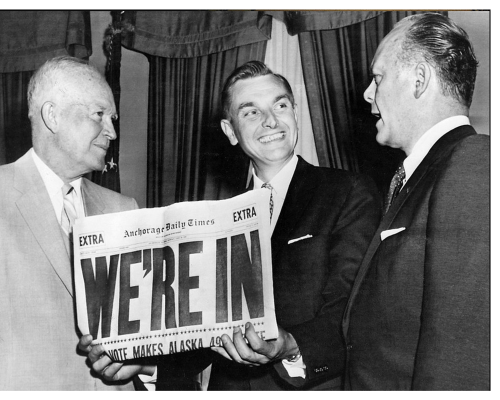
Happy Alaska Statehood Day, January 3!

On this day, 1959, President Eisenhower signed the Alaska Statehood Act. This photo is of Pres. Eisenhower with Mike Stepovich, Alaska Territorial Governor, and Frank Seaton, Sec. of Interior. (I went to grade school with one of the Stepovich sons, in Fairbanks.)

A link to more on history here.


Ballot Initiatives and Signature Gathering

Question from constituent:

Why are people asking me to sign an initiative that says "voters must show ID in order to vote" and "only Alaska residents" can vote? Isnt this already the law in Alaska?


Answer: Well, yes! But it turns out that the signature gatherers were "misrepresenting" the petition they were asking people to sign.


Here's the actual signature-gathering petition:

25USCV

An initiative to require that only United States citizens may be qualified voters in Alaska elections.

Petition Status: Petition booklets circulating

·    Petition Booklet Filing Deadline:

·    October 29, 2026

Download petition documents


There's nothing about Voter ID being required, as the signature gatherers told people. The petition is to establish a law that only US citizens can vote in Alaska.


Here's our law now...

The Alaska Constitution, Article 5, section 1: requires that the person be a "citizen of the U.S.", and "shall have been, immediately preceding the election, a 30-day resident of the election district".

This requires U.S. citizenship and Alaska residency.

In addition, voters must show ID before voting at any Alaska polling place. For mail in ballots, some form of ID must be submitted.

These laws and procedures are already in place in Alaska, and are being enforced.


A constituent talked to the signature gatherers. It turned out that they were from Idaho and were being paid $14 an hour plus airfare and expenses to gather signatures during what they described as a "3 week vacation to Alaska." Neither had been here before and were quite excited about the trip and the whole concept of Alaska. Needless to say, they were clueless about anything related to the petition or politics in Alaska. They did share that they would be in Girdwood for a couple more days before going to "Sea-ward" for a few days. They also inquired if there were better places in Girdwood to collect signatures than the PO and shared that they had been prohibited by several businesses in Anchorage.


And there's more that this constituent found out: He asked to see the actual petition booklet to find out what they were actually doing. He was surprised when the actual petition said nothing about showing voter ID.

Here it is: "An initiative to require that only United States citizens may be qualified voters in Alaska elections."  (This link will let you see the actual measure being proposed)


As I noted at the beginning, US Citizenship is already a provision in our State Constitution. Voters provide ID when voting, both in person and by mail.


What if someone signed this petition and now realizes they should not have signed it?

A person can withdraw their signature using the form linked here: http://www.elections.alaska.gov/doc/forms/H39.pdf. They will need to add the petition identifier (25USCV) and include a voter identifier (Voter Number, ADL, DOB, SSN or last four SSN and return the form to DOE before the signatures are submitted.


What is the "Why" for these initiatives? Unknown to me! Its already law. And its being enforced, as an issue Whittier bears out.

Whittier Voter Misconduct Case. Alaska News Source


Opinion: Alaskans, don’t be duped by the citizens voter initiative - Anchorage Daily News

Alaska already requires voters to be U.S. citizens. Election officials enforce that rule. There is no bill in Juneau proposing to change it, no court case challenging it and no Alaska municipality contemplating noncitizen voting. Nothing in our election history or law suggests that the state’s citizenship requirement is under threat.


Items in this Newsletter:

·    Court Rules in Favor of Legislature

·    Rural Health Transformation Funds

·    Vaccines

·    Current Topics, Stuff I Found Interesting, Arctic Issues, Economy, Education, Politics, Healthcare

·    Railbelt Reliability Council Webinar

·    Holiday Tree Recycling

·    Alaska History in January

·    Resource Values, Permanent Fund


Superior Court Finds in Favor of Legislature


On August 1 the Governor issued an Executive Order #137, creating a new state government department, Department of Agriculture. This was a repeat of an EO offered during the regular session in 2025, which the Legislature rejected.


The Governor asserted that the Legislature must address the same topic again in the August 2, 2025 Special Session. The Legislature declined to do this, stating that the EO violated the Alaska Constitution, Art.III, sec. 23.


Because the Legislature declined to act, the Governor asserted that he would create the Dept of Agriculture despite the Legislature. In fact, the December FY27 Budget submitted by the Governor contains $10 Million appropriation for this new Department.


The Legislative Council (a bipartisan, bicameral committee of the Legislature) voted to take this topic to the Judicial Branch to clarify.


On December 31, 2025, Superior Court issued "Order Granting Legislative Council's Motion for Summary Judgment and Denying Governor Michael Dunleavy's Cross-Motion for Summary Judgement.

Read the Order here.


Rural Health Transformation


The Department of Health submitted ideas to transform healthcare in Alaska.

These 5 areas:

·    Healthy Beginnings: prenatal & postpartum care, infant care, child care, in-school programs, after-school activities

·    Healthcare Access: integrated primary/behavioral health, integrating oral health care, specialty are, urgent and emergencies services, aging-in-place/home & community-based services, post-acute & recovery care

·    Healthy Communities: consumer-facing digital tools for chronic disease self-management, data infrastructure to support population health management, mobile primary & preventive care units, evidence0based community programs for health education, increased health literacy, adoption of healthy behaviors, effective management of chronic disease, wellness centers, transportation access, technical assistance to communities

·    Pay for Value/Fiscal Sustainability: develop & pilot alternative payment models, build capacity, invest in resources

·    Strengthen Workforce: robust pipeline & recruitment, retain rural providers, implement provider training and certification programs


I have not seen the details of their plans.

Nor have I seen what they promised Alaska would do, now that the Feds have given us this "free" money.


My concern is that Department of Health is badly understaffed (Governor's staffing cuts and hiring freeze), and the staff they have are new, under-prepared for their jobs (evidenced by the annual State audit findings of errors in Federal money management.)


More information will become available and I'll pass it on.

Sullivan is on a quest to rebrand Big, Beautiful Bill to Alaskans. ADN

Polling shows Alaskans remain skeptical. The flow in the metaphorical pipeline connecting oil revenue to Alaskans’ pockets has slowed to a trickle. To live in Alaska is to contend with some of the highest, if not the absolute highest, health care and grocery prices in America. Many Alaskans look at the budget reconciliation bill and see no reprieve from the rising costs that govern their everyday decisions.

(My comment: READ the POLL (linked) Just read the article to see my thoughts.)


Alaska gets $272M in federal funds for ‘rural health transformation’. ADN

Governor announces approval of millions for rural healthcare in Alaska. Alaska News Source

Alaska could see up to $1.36 billion for rural health over the next 5 years. Alaska Beacon

Alaska’s is the second-largest award among all 50 states, after Texas’ $281 million, and above the average of $200 million per state. When taking into account population size, Alaska received $368 per resident — the highest per-capita award in the nation. Texas’ award, by comparison, amounts to $9 per resident.

The $1.36 billion the state is slated to receive over the next five years is the biggest investment from the federal government to Alaska’s health care system in state history.

Sen. Lisa Murkowski, R-Alaska, challenged the state administration and legislators to take on the question of rebuilding the state’s health care system as a major issue. She said she was worried about the reliability of the funding because the state could fail to make the most of the opportunity or because the federal government could pause or cancel the funding. “I know that we’re going into an election year next year. I know that the Permanent Fund always takes up space. I know we’re going to be talking about the gas line,” she said. “But we must, we must absolutely be talking about this health care opportunity that we have in front of us now.”

(My comment: I agree with Senator Murkowski: we have to use these funds wisely and monitor where the funds are going. Congressman Begich told Legislators during his February 2025 visit that Alaska "has to get of Federal money". Now he's applauding a massive grant from the Federal government; where does he really stand?)


$1.36 billion for rural healthcare comes with catch: Alaska must pass laws lawmakers say they weren’t briefed on Alaska News Source

Alaska set to receive $272M to overhaul its rural health care system Alaska Public Media

Stevens said senators will have “a lot of questions” on how the funds will be used and who can use them. He said he wasn’t clear on what the funds could be used for, adding they may not cover building new buildings or replacing Medicaid. The funding would expand access to healthcare in rural communities, strengthen the healthcare workforce, and modernize health records systems—but only if the legislature approves policies the Health Department committed to in its application.


Opinion: Let’s start the new year by acting on Alaska’s affordability crisis Anchorage Daily News

Tackling Alaska’s energy crisis is our most urgent challenge to keep the cost of living manageable for Alaskans. 


Reaffirming Hepatitis B Vaccine Birth Dose

State of Alaska,

Dept of Health

Division of Public Health

Epidemiology Section

December 29, 2025


In the 1970s, Alaska Native (AN) communities experienced HBV prevalence as high as 23% and the world’s highest pediatric HCC rates.


Up until recently, Western Alaska was the only region in the United States where HepB was endemic.


Through comprehensive screening, mass vaccination, and sustained universal newborn immunization, HBV transmission has been virtually eliminated in these communities, highlighting the success of long-term, population-based vaccination programs.


Read the Bulletin HERE


Current Topics

Southcentral Utilities Say Cold Snap Hasn't Strained Gas Supplies. ADN

The natural gas utility for Southcentral Alaska said a prolonged cold snap in recent weeks increased the demand for gas from the region’s main storage facility. But the facility, called Cook Inlet Natural Gas Storage Alaska, still contains enough gas to meet demand, said Lindsay Hobson, a spokeswoman with Enstar.

(My comment: Such good news, plus the added gas from HEX/Furie drilling work In Cook Inlet this last summer. BUT...we still have an issue for the future! Don't go to sleep on this one.)


Temperatures will plummet in SC this weekend. ADN


Bought a car in Alaska? State orders refunds over hidden fees. Alaska's News Source

The State of Alaska has reached a settlement with Lithia Motors Inc. after an investigation found some of the company’s Alaska dealerships charged customers fees that were not included in advertised vehicle prices, Attorney General Stephen Cox announced Monday. Under the settlement, Lithia will pay a $300,000 civil penalty, provide restitution to affected customers and conduct regular audits of its advertising to ensure compliance with Alaska law.


Online bookings just opened for a new cabin in Chugach National Forest. ADN

A new public-use cabin near Hope opened for bookings Monday in the Chugach National Forest, part of a project designed to make cabins more accessible.


‘Locked down’: Crime at Anchorage big box stores prompts new strategies. ADN

Officials say the combination of a yearslong national upturn in retail crime and a period when the city didn’t prosecute hundreds of low-level misdemeanors such as shoplifting converged into a situation where thieves sensed impunity.


US Supreme Court to Consider Alaska Subsistence. ADN

The U.S. Supreme Court will soon consider whether or not it will review a lower court’s decision in a case involving subsistence fishing that pits the state of Alaska against the federal government and Alaska Natives.


Things That I Found Interesting

Charted: Silver vs. oil. Axios

One troy ounce of silver is now worth more than a barrel of oil in futures markets.


Fuzzy memories of a very real Alaska cold snap in 1989. ADN


Utqiaġvik artist to create a learning workbook to help preserve Iñupiaq language. Alaska Public Media

The workbook is just the most recent example of efforts to revitalize the language that have been sweeping across northern Alaska. Another one is an Iñupiaq version of the popular game Wordle, which was launched by linguists a few years ago.

(My comment: How fun! Helpful to the rest of us, not native speakers!)


Arctic

Coast Guard issues contract to build icebreakers in Louisiana and Finland. Stars and Stripes

Shipyards in Louisiana and Finland will jointly build six new Arctic Security Cutter icebreakers, the U.S. Coast Guard announced Monday. Bollinger Shipyards of Lockport, La., and Rauma Marine Constructions Oy of Rauma, Finland, received the contracts as part of an international agreement negotiated by the Trump Administration. The contract with Rauma Marine Constructions Oy is for two cutters to be built in Finland, with delivery in 2028. The Bollinger contract includes up to four ships, with delivery in 2029.


Economy

Social Security ends year in turmoil as record backlogs delay services. ADN

Long-strained customer services at Social Security have become worse by many key measures since President Donald Trump began his second term, agency data and interviews show, as thousands of employees were fired or quit and hasty policy changes and reassignments left inexperienced staff to handle the aftermath.


Charted: Silver vs. oil. Axios

One troy ounce of silver is now worth more than a barrel of oil in futures markets.


Elections

Another Initiative to Repeal Open Primaries. ADN

A group seeking to repeal Alaska’s open primaries and ranked choice voting has gathered enough signatures to place the question on the November 2026 ballot, according to Lt. Gov. Nancy Dahlstrom.

(My comments: Read article to see my view on this topic.)


Opinion: Alaskans, don’t be duped by the citizens voter initiative - Anchorage Daily News

Alaska already requires voters to be U.S. citizens. Election officials enforce that rule. There is no bill in Juneau proposing to change it, no court case challenging it and no Alaska municipality contemplating noncitizen voting. Nothing in our election history or law suggests that the state’s citizenship requirement is under threat.


Alaska joins states providing voter data to Trump’s DOJ. Juneau Independent

Dahlstrom, in a prepared statement, said she is aligned with Trump’s stated goals. “Alaska is committed to the integrity of our elections and to complying with applicable law,” said Lt. Governor Nancy Dahlstrom. “Upon receiving the DOJ’s request, the Division of Elections, in consultation with the Department of Law, provided the voter registration list in accordance with federal requirements and state authority, while ensuring appropriate safeguards for sensitive information.”


Politics

Dunleavy appoints 2 Mat-Su Republicans to fill vacant Alaska House seats. ADN

Dunleavy chose Garret Nelson, an online salesman and father of nine who lives in Sutton, to fill a seat previously held by George Rauscher. The governor selected Stephan St. Clair, a veteran and former legislative staffer from Wasilla, to fill a seat previously held by Cathy Tilton.


Health Care

Thousands of Alaskans are facing a health care 'cliff' amid gridlock in Congress. ADN

In a statement earlier this month, Begich blamed the Affordable Care Act for rising costs, and celebrated a House GOP health care bill that did not extend the subsidies. That bill passed the House before the holiday recess but was not considered in the Senate. 

“We must now construct a system that delivers results — a system where Americans can honestly say they are getting their money’s worth,” Begich said in a statement.

(My comment: The above statement and compete lack of understanding of this issue is appalling and completely out of touch with Alaska families and businesses.)


Disability and Technical Issues Were Key Barriers to Meeting Arkansas’ Medicaid Work and Reporting Requirements in 2018 Kaiser Family Foundation

The HB 1 (Congress) passed this year requires able-bodied adults aged 19-64 to complete 80 hours/month of qualifying volunteer activities (work, community service, education, etc.) in order to receive coverage.

(My comment: Medicaid recipients in Alaska are nearly all already working. But they don’t earn enough to afford the highly escalating “Marketplace” health insurance costs. One third (1/3) of Alaskans rely on Medicaid benefits. If they no longer qualify, where do they turn for healthcare? Hospital emergency rooms are the most expensive point of care and the uncompensated cost of that care is pushed on to patients who have insurance – which drives up insurance premiums even higher. On and on it goes. HR 1 does nothing to reduce cost for Alaskans or the government.)


Reaffirming the Hepatitis B Vaccine Birth Dose. State of Alaska, Dept of Health, Division of Public Health, Epidemiology Section 

In the 1970s, Alaska Native (AN) communities experienced HBV prevalence as high as 23% and the world’s highest pediatric HCC rates.² Up until recently, Western Alaska was the only region in the United States where HepB was endemic. 2 Through comprehensive screening, mass vaccination, and sustained universal newborn immunization, HBV transmission has been virtually eliminated in these communities, highlighting the success of long-term, population-based vaccination programs. 


This is your teen’s brain on phones and social media, according to science. ADN

The numbers suggest screens are taking a broader, deeper toll on teens than many expected. Across multiple studies, high levels of screen use are linked to measurable declines in cognitive performance - slower processing speed, reduced attention and weaker memory. Rates of depression and anxiety climb steadily with heavier social media engagement. Sleep quality deteriorates as screens encroach later into the night, and researchers are finding troubling associations between screen habits and rising adolescent weight gain.

Their work also found differences in the type of online activity and risk. Children who had high and increased use of video games had more internalized mental health challenges such as anxiety and depression, while those with high and increasing social media use tended to have more externalizing behaviors such as rule-breaking and aggression.


States invest in child care more than ever to help parents with rising costs. ADN

Now, more Missouri employers will be able to help their workers pay for child care thanks to a new state-funded program, approved by lawmakers in May and launched last month. Through the initiative, employers can sign up to offer child care benefits to workers. The cost is split among the state, parents and employers, who can claim a tax break.


Alaska gets $272M in federal funds for ‘rural health transformation’. ADN

Governor announces approval of millions for rural healthcare in Alaska. Alaska News Source

Alaska could see up to $1.36 billion for rural health over the next 5 years. Alaska Beacon

Alaska’s is the second-largest award among all 50 states, after Texas’ $281 million, and above the average of $200 million per state. When taking into account population size, Alaska received $368 per resident — the highest per-capita award in the nation. Texas’ award, by comparison, amounts to $9 per resident.

The $1.36 billion the state is slated to receive over the next five years is the biggest investment from the federal government to Alaska’s health care system in state history.

Sen. Lisa Murkowski, R-Alaska, challenged the state administration and legislators to take on the question of rebuilding the state’s health care system as a major issue. She said she was worried about the reliability of the funding because the state could fail to make the most of the opportunity or because the federal government could pause or cancel the funding. “I know that we’re going into an election year next year. I know that the Permanent Fund always takes up space. I know we’re going to be talking about the gas line,” she said. “But we must, we must absolutely be talking about this health care opportunity that we have in front of us now.”


Webinar to Introduce the Integrated Resource Plan


The Alaska Railbelt Reliability Council (RRC) invites you to a public webinar on January 8, 2026, at 12:00 p.m. AKST. This session will provide the public with an overview of the Integrated Resource Plan (IRP) process and explain how to get involved.

This is the Railbelt’s first-ever IRP — a comprehensive, long-term strategy for ensuring that the power system serving most Alaskans stays reliable, affordable and ready for the future.

Over the next two years, the IRP process will include public meetings, technical workshops and opportunities for Alaskans to ask questions and share feedback. The final plan is expected to be submitted to the Regulatory Commission of Alaska in early 2027.

Don’t miss this chance to learn more and participate in shaping Alaska’s energy future!


Alaska History

·    1921 Jan 24 - Alaska's first pulp mill opened in Juneau

·    1925, Jan 27 - first dog team left Nenana with serum for Nome for deadly diphtheria outbreak (serum arrived in Nome 6 days later)

·    1946, Jan 13 - First issue of the Anchorage Daily News

·    1959, Jan 3 - President Eisenhower signed Alaska Statehood Proclamation

·    1959, Jan 18 - Direct Long Distance phone service to Alaska began

·    1964, Jan 1 - North Star, Kenai Peninsula, and MatSu Boroughs all formed

·    1966, Jan 2 - Sitka fire destroyed St. Michaels cathedral

·    1970, Jan 1 - City & Borough of Juneau formed

·    1971, Jan 23 - Coldest recorded temperature (-80 F) at Prospect Creek Camp

·    1985, Jan 5 - Federal government sold the Alaska Railroad to the State of Alaska

·    1988, Jan 14 - record 2.145 million barrels of oil went though TAPS in one day

·    1989, Jan 31 - record North American high pressure of 31.85 inches of mercury in Northway, Alaska

·    1990, Jan 16 - record 47.5 inches snowfall, Valdez

·    2025, Jan 7 - Eastern Orthodox Christmas

·    2025, Jan 22 - First Sunrise in Utqiagvik (after 65 days of no sun)


Alaska Resource Values


Alaska North Slope crude oil price (12/30/25): $62.51

FY26 budget (beginning 7/1) is fully funded at

$64/barrel of oil.


History of prices:

12/17/25: $60.06

9/2024: $63.63

9/30/23: $87.99

9/30/22: $86.91

6/29/22: $116.84

3/08/22: $125.44

12/22/21: $75.55

March 2020: $12.29

7/3/2008: $144.00

ANS production (12/30/25): 472,294 bpd


Charted: Silver vs. oil. Axios

One troy ounce of silver is now worth more than a barrel of oil in futures markets.


Precious Metal Prices

December 31, 2025

Gold - $4317.60

Silver - $71.54

Platinum - $2066.00

Palladium - $1604.00

Rhodium - $981.00


Alaska Permanent Fund

website

The projected payment to the state General Fund for upcoming Fiscal Year 2027, under the Percent-of-Market-Value (POMV) formula, is to be $4 billion, up from $3.8 billion for FY 2025, the current year.


The Fund’s rate of return over five years has been 9.54%

• For the first three months of the FY 2026 fiscal year, or July 1 through September 30, the Fund had $2.21 billion in “statutory net income.” 


Fund value December 15, 2025 - $87,552,600,000

PFD payout from ERA, Fiscal years 1982-2025: about $33 billion

Over $100 billion total earnings over lifetime of the Permanent Fund


Feedback is always welcome.

Have a great week!


Cathy 


Personal Contact:

907.465.4843

sen.cathy.giessel@akleg.gov


Past Newsletters on my website


My Staff:

·    Chief of Staff: Jane Conway (from Soldotna)

·    Legislation Aide: Paige Brown (from Anchorage/Girdwood)

·    Resources Committee Staff: Inti Harbison (from Anchorage)


Copyright © 2026. All Rights Reserved.


Senator Cathy Giessel's Newsletter | 12701 Ridgewood Rd | Anchorage, AK 99516 US