|
Current Topics
PODCAST: The 34th Legislature’s 2nd session Talk
of Alaska
Dunleavy
calls fiscal plan a ‘sacrifice’ of political goodwill as it meets
tepid response from lawmakers, industry ADN
Dunleavy’s
statewide sales tax repeals local exemptions on food, utilities — but
city may lose far more than it receives Juneau Independent
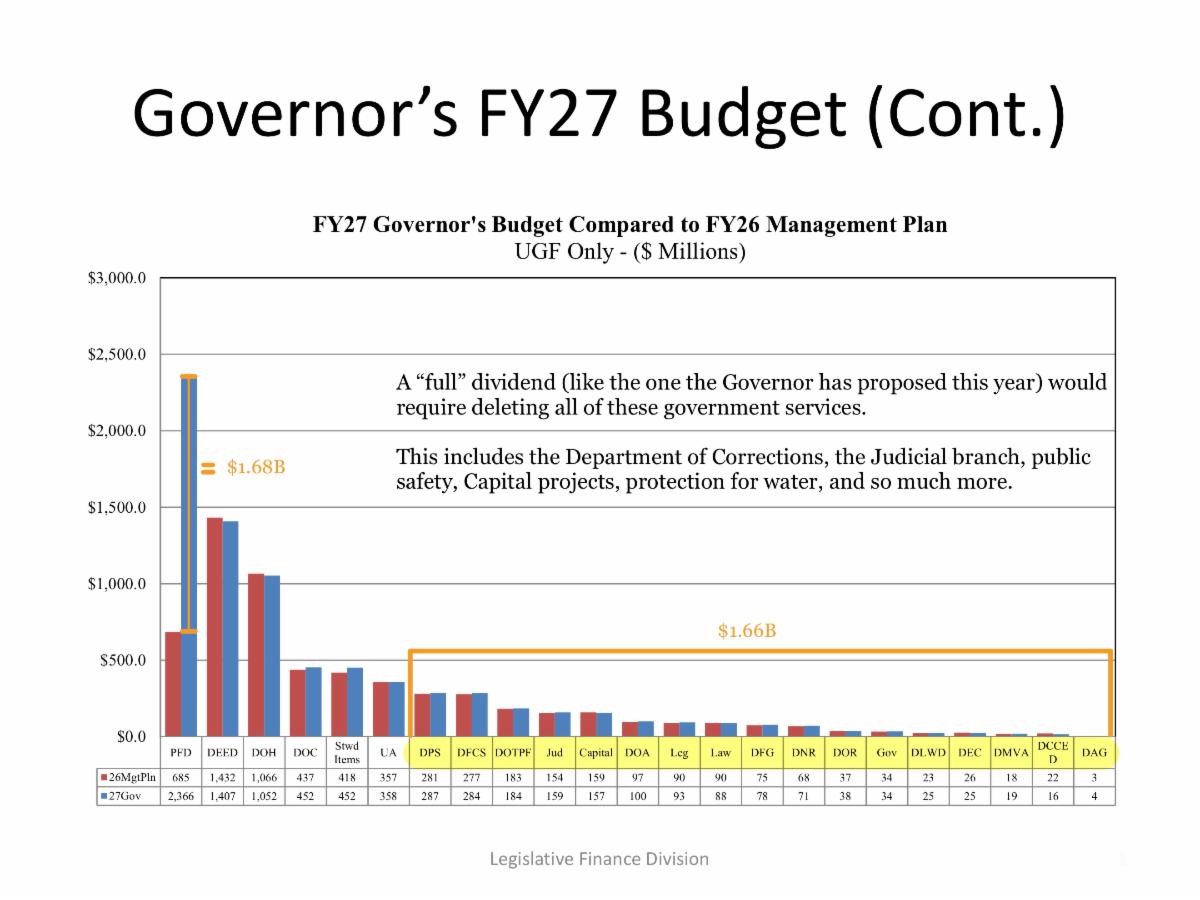
Dunleavy spent much of his
tenure opposing new taxes and asking lawmakers to approve massive
draws from savings to cover the cost of state government. Now, he is
proposing to address the state’s structural deficit by levying a new
statewide sales tax, revising the calculation for the annual
Permanent Fund dividend, imposing an increase in taxes on the state’s
oil industry and phasing out the state’s existing corporate income
tax.
Opinion:
A decade has passed, but the existential threat to Alaska’s future
remains ADN
Ten years ago, I was
helping launch
a grassroots effort called Our
Alaska alongside
two other women. We were in our late 20s and early 30s, and we were
worried about the state’s fiscal future. At the time, Alaska was
confronting what was then called a looming “fiscal cliff.” Oil prices
had collapsed. Deficits were mounting. Savings were being drained at
an alarming rate. Yet the public conversation felt muted, technical
and strangely detached from urgency.
Alaska’s fiscal plan: A
start in the right direction with questionable execution ADN
As proposed, Alaska would tax
its residents with one hand, only to pass out government checks in
the form of a PFD with the other. That’s a classic redistribution of
wealth, carried out through two expensive bureaucracies. If that
doesn’t make any sense to you, you’re not alone. A simpler, fairer
and more realistic approach would be to use oil revenue and Permanent
Fund earnings to fund state government first, then distribute a
sensible dividend from whatever revenue remains.
Opinion: Dessert first is
no way to run Alaska’s budget ADN
Don’t
have a REAL ID or other acceptable form of identification? Starting
Sunday, you’ll have to pay up to get on a plane Alaska News Source
Travelers who don’t have an
acceptable form of ID will have to pay a $45 fee to the TSA to verify
their identity and get through security screening, starting Sunday,
Feb. 1. More than 94% of Alaskans use an acceptable form of ID,
according to state records, about half the population has received
REAL IDs. People can go to the TSA
website to see a list of acceptable ID’s.
Alaska
House approves tougher standards for resident hunting, fishing
licenses Alaska Beacon
Alaskans seeking to get
resident hunting, fishing and trapping licenses may soon need to meet
most of the same standards needed to get a Permanent Fund dividend.
In a 27-12 vote Friday, the Alaska House of Representatives
approved House
Bill 93, which would apply PFD-like residency restrictions to
hunting, trapping and fishing license requirements. Leading the
opposition to the bill was Rep. Kevin McCabe, R-Big Lake, who
unsuccessfully attempted to amend the bill with an exemption for airplane
pilots who may work out of the state.
Vexed
lawmakers told it will take ‘at least a year’ to assess report
calling state pay uncompetitive Juneau Independent
State employees hoping they
might see a pay hike due to a study declaring their wages
uncompetitive may be in for a long wait, as a Dunleavy administration
official said Monday the plan is to spend "at least a year"
assessing how the study’s recommendations can be implemented.
"I've always wondered what the word Byzantine bureaucracy meant
and I feel like after today I kind of know that," Rep. Will
Stapp, R-Fairbanks, said during the back-and-forth questioning.
"This issue has been going on a long time. I don't think in all
the meetings that we had on the salary study it was ever mentioned
that we would ever have required a classification study. So I do feel
like this is basically being stuck in a bureaucratic malaise that is
slowly grinding my soul into powder."
(My comment: It has been the
mission of this Governor’s administration to reduce the size of
government. This has been executed with severe budget reductions and
hiring freezes. It would be a 180 degree turn for this administration
to update salaries. So this idea of “at least a year” to implement
the was increases is exactly the time left in this administration.)
Things That I Found Interesting
Alaska
population rises slightly, but more people continue to move out than
move in Alaska Beacon
after prodding from Alaska
state demographer David Howell, the Census Bureau retroactively
lowered the number of international migrants that came to Alaska, and
this year’s population estimate is significantly lower than last
year’s but higher than the state’s revised 2024 figure. With the
extra residents removed and a new baseline in place, the state’s
population grew on a year-over-year basis because the number of
births in the state exceeded the number of Alaskans who died.
(My comment: Did you know
Alaska had a demographer? Thanks to Mr. Howell, our population
numbers are closer to accurate. Still concerning is that natural
increase — births minus deaths — of 3,389 people was greater than the
number of people who moved out of the state.
Arctic
Alaska
again seeks American shipyards to build new oceangoing Tustumena
replacement ferry Alaska Beacon
After more than a decade of
planning, design and false starts, the state of Alaska is once more
attempting to build its first new mainline ferry in decades.
Snow
loads aren’t stressing Anchorage roofs, for now. Alaska Public Media
Since the ‘60s, municipal
code has required roofs in the Anchorage Bowl to withstand 40 pounds
of snow per square foot of roof, known as PSF. Soule said right now,
we’re at about 20 PSF.
Alaska
Native corporation seeking OK to build winter roads in Arctic refuge
coastal plain Alaska Beacon
The Kaktovik Iñupiat
Corporation says a seasonal ice and snow road link is unrelated to
oil but needed to reduce costs and improve life in the isolated
village.
Alaska
Native group sues Trump administration for nixing North Slope caribou
protections Alaska Beacon
Representatives of Nuiqsut,
an Inupiat village on the North Slope, have sued the Trump
administration over the abrupt cancellation of a program that gave
protections to the Teshekpuk Lake area and the caribou herd that uses
it. Teshekpuk Lake is the largest lake in the Arctic region and known
as a diverse and sensitive wetland ecosystem.
“You
can literally feel your ancestors walking with you” - Indigenous
fashion show showcases Alaska Native heritage. Alaska News Source
Students and families
gathered at Bettye Davis East Anchorage High School Saturday for the
Indigenous Education Student Fashion & Vendor Show.
Education
It's
easy to understand teacher turnover in Alaska Alaska Beacon
Teachers must hold degrees in
education. Teachers must pass national exams. They are vetted by the
state for certification. Yet teachers aren’t respected as
professionals. The current push for school choice and parental rights
combined with the proliferation of low accountability education
options like correspondence schools send a clear message to career
educators: Anyone can do your job.
(My comment: “The Smartest
Kids in the World” (Amanda Ripley) tells the story of Finland, with
the “smartest kids in the world”. Teachers there are esteemed higher
than attorneys and physicians. They are respected, paid well, have
retirement pensions. Students and parents respond accordingly. This
doesn’t exist in the US and certainly not in Alaska.)
A
$50M literacy grant is helping Alaska schools, but some districts say
it’s tough to access funds Alaska Beacon
While Alaska school districts
are seeing
improvements in kindergarten to third grade students’ reading
proficiency, which officials credit to the Alaska Reads Act, some
districts are struggling to access state managed funds for a federal
grant program aimed at supporting literacy programs, teacher development,
and student learning.
Anchorage
School District proposes major cuts to positions, programs, sports
and more ADN
Anchorage
School District faces $90M deficit, proposes cutting hundreds of
positions. Alaska
News Source
The Anchorage School District
released a preliminary budget on Friday that cuts over 500 positions and
increases class sizes. To balance a $90 million structural deficit,
the district’s budget proposal makes significant cuts to classroom
teachers, school nurses, sports programs and administrative
positions.
Dunleavy
opts Alaska into federal tax credit scholarship program that could
benefit private schools ADN
State officials and some education
advocates are at odds over the legality of a new federal tax credit
scholarship program that Gov. Mike Dunleavy signed Alaska on to. The
program — which passed as part of the One Big Beautiful Bill Act
budget reconciliation measure last year — would give
federal tax breaks to families who donate to independent nonprofit
Scholarship Granting Organizations, which have not yet been
established in Alaska. A prepared
statement from the state Department of Education and Early
Development said the money could be used for tuition or
fees at private schools, charter schools and homeschools, among other
expenses. Money could also be donated to public schools.
Anchorage
teacher union votes in support of tentative agreement Alaska News Source
Members of the Anchorage
Education Association voted to pass a tentative agreement with the
Anchorage School District after weeks of negotiation, according to
AEA president Christi Sitz. The agreement includes a 17% pay increase
spread over four years: 3% for the remainder of this school year, 5%
each of the next two years and 4% in the final fourth year. Teachers
will also receive a $200 monthly increase for health insurance.
Anchorage
teachers union ratifies 3-year contract with school district ADN
Anchorage
School Board approves new 3-year teacher contract AK PUB
Anchorage
School Board takes deeper look at budget cuts KTUU
(My comment: I recommend a
book, “The Smartest Kids in the World” by Amanda Ripley. The clear
winner is the country of Finland, a circumpolar country like Alaska.
In Finland education is prioritize and teachers are regarded with
respect. Teacher education is very competitive, credentials matter,
and teachers are valued. In turn, parents convey that respect and
importance of education to their children. As a result, student
performance matches and results in the “smartest kids in the world”.
The U.S. and Alaska is the opposite. We could do better. We could
recognize the value of teachers, who are nurturing and inspiring
students. We could respect and support them.)
Energy
🏃 Catch up quick on batteries Axios
Data center developers are
increasingly adopting batteries to help manage energy load.
Lawmakers
‘not convinced’ Alaska roads are ready for LNG pipeline construction. Alaska News Source
“I’m concerned that we
aren’t prepared for all of this,” Sen. Cathy Giessel, R-Anchorage,
said following the committee hearing Wednesday. “We’re going to need
to have significant amount of cash on the table to pay for these
improvements. At the same time, I’m concerned that even our
Department of Transportation doesn’t have more detailed information,
or perhaps they have it, but they simply can’t share it with us. This
project is completely behind closed doors,” she added. “We can’t see
any of it. So it’s a challenge.”
Abu Dhabi's XRG raises Rio
Grande LNG project stake Reuters
Abu Dhabi state energy
company XRG said on Monday it is buying an additional 7.6% stake in
two liquefied natural gas trains at the Rio Grande LNG project in
Texas, deepening its investment in one of the world's largest export
facilities.
New
transmission line connecting Hydro-Quebec to ISO-NE begins commercial
operations EIA
On January 16, 2026, the
New England Clean Energy Connect (NECEC), a 1,200 megawatt (MW)
transmission line project, began commercial operation. The new high-voltage direct current NECEC transmission line is primarily
intended to increase the amount of hydroelectric power exported from
Canada to New England.
(My comment: This HVDC
transmission line is the same type of transmission proposed for Cook
Inlet to transmit Bradley Lake Hydro to Southcentral Alaska.)
Opinion:
Alaska must proceed with caution on gas line legislation ADN
Glenfarne recently
announced it has updated the long-cited $44 billion cost estimate for
the project but has declined to release the new figure
publicly. The potential for conflicts of interest deserves
scrutiny as well. Glenfarne’s involvement in both a gas line intended
to supply Southcentral Alaska and planned Cook Inlet LNG import
facilities raises an obvious question: Could imported LNG compete
with gas from the pipeline project? On a project this large and
risky, prudence is not obstruction. It is responsible stewardship.
Bonus:
China's mineral dominance, charted Axios
Small
oil and gas firm moves to take advantage of Alaska’s gas pipeline
prospects Alaska
Beacon
A small independent oil and
gas company on the North Slope is making a bet on construction of the
proposed trans-Alaska natural gas pipeline, a
new regulatory filing reveals. According to the Alaska Department of
Natural Resources, Strong Energy Resources of Texas has asked the
state to designate a new oil and gas unit on the North Slope, an
administrative change that the company says would position it to
produce gas for the pipeline.
(My comment: Another Texas
oil company, an S-corporation which will pay no corporate tax to
Alaska, has realized what a tax-free place this is.)
Politics
America's Place in the world. Axios
Imagine a world where ties to the U.S. feel like a burden, not a
benefit to free society.
Trump
administration denies full disaster funding for Western Alaska
storms, state files appeal. Alaska Beacon
Federal
government denies Dunleavy request that it fully pay for initial
storm response in Western Alaska ADN
That leaves the state on the
hook for millions of dollars for disaster recovery, however the full
amount is still unknown.
Opinion:
The tyranny of quotas - ADN
Health Care
Alaska
officials uncertain on bills needed to keep $1.36B in health funding. Alaska News Source
Alaska must pass
legislation by 2027 to keep its full $1.36 billion in federal rural
healthcare funding, but state officials told lawmakers Thursday they
don’t yet have a clear plan for how to do it.
The
Evolving Landscape of State Health Care Transaction Laws NCSL
Rising health
care costs and consumer affordability remain top of mind
for many state policymakers. As of 2022, the United States was spending
double the
amount per person on health care compared to other high-income
countries. Several factors contribute to rising health care costs.
Experts attribute this growth largely to increased
prices for
services, including more
spending on administrative costs of the provider or
insurer, prescription drugs and wages, rather than high utilization
of services. Research suggests that health care market
consolidation is a driver
of prices and that mergers and acquisitions involving
private equity firms has led to increased
health care costs and utilization.
The
cost of health care, not food or rent, is now Americans’ top worry ADN
Americans are worried
about their bills for groceries, housing and utilities. But their
biggest pocketbook anxiety arises from the cost of health care. Over
the past five years, the price of health coverage for an employee’s
family has risen 26 percent, to $27,000 annually, according to a
different KFF survey.
Alaska
has second-lowest child vaccination rate among 48 states reporting
results Juneau
Independent
Kindergarten vaccination
rates in Alaska are the second-lowest among 48 states reporting data,
with rates decreasing nationwide due to increasing exemptions and
misinformation, according to reports and data published Monday.
|