Senate Majority Bipartisan Coalition Website

State Senator District E

Senate Majority Leader


Senator Cathy Giessel Newsletter

UPDATES


Issues affecting

your family, community and jobs.


June 19, 2026


Dear Friends and Neighbors,

Photo: Sadly, a broken robin egg on my driveway!


Special Session - Day 30

Today is last day of the 2nd Special Session, 34th Legislature.


Gas Pipeline - only special session topic


My thoughts on desired changes to the bill:

I am very much pushing for an expiration date on any pipeline bill passed today or in the future.

The bill before us today is wildly generous and should not stay on the books, to be used in another situation. 

The Final Investment Decision (all the investors, cost analysis, etc) on the pipeline segment bringing gas to Alaskans must be required completed by Jan. 1, 2028.

The pipeline itself must be functioning by December 31, 2032. ENSTAR’s firm natural gas purchase contracts  with Cook Inlet producers expire in 2033.

In exchange for hundreds of millions of dollars in tax relief, Glenfarne must have a functioning gas pipeline to southcentral before 2033.

If this is not met, the entire financial agreement for the project should be repealed. All assets and ownership of Glenfarne should revert to AGDC/the State with no cost.


Project Labor Agreement in a MOU should be codified in the gas pipeline bill. It would solidify the prevailing wage agreement and utilization of apprenticeship programs.

The agreement requires no less than 15% of the hours worked be performed by apprentices in federally registered apprenticeship programs.


Inflation Rate Equity: In the present bill, the inflation rate for the property tax (as an AVT) is limited to 2% inflation.

But the price for consumers, capped at $16/mmbtu, will inflate by full inflation, effective immediately. 

I want this inflation rate to be equitable!! Glenfarne’s property tax (AVT) needs to inflate at the same rate as consumer gas prices.


Property tax reductions should expire after 10 years after LNG begins to export. Then the mill rate, set about 2 mills, should begin to increase by 4 mills every 4 years, until the full State Property Tax of 20 mills is reinstated.


Corporate Income Tax: Glenfarne is forecast to earn about $5 Billion per year when this project is completed and exporting gas (Alaska Dept of Revenue projection). They have said that they intend to remain the owners throughout its function, which means they will be netting large profits.

Glenfarne is a Limited Liability Company, meaning they pay no corporate income tax to the state on those profits. This is true of other companies in Alaska as well, organized as “pass-through entities”. Their taxes would be paid on the individual owners’ income taxes. Alaska has no personal income tax, meaning these company profits go untaxed by Alaska. We can correct that error in our tax structure through this bill.


Issues Left Undone

45Q Tax Credit Earnings. The Gas Treatment Plant on the North Slope will remove the CO2, sulfur, and other impurities from the gas before it is shipped in the pipeline. That CO2 will be injected deep into the ground (sequestered).

The Federal government has a tax credit referred to as 45Q. Companies doing this earn $135 million/tonne; if producers do this, they earn $85/tonne of CO2 injected. Glenfarne, as a private company, will be able to make hundreds of millions of dollars on sequestration under 45Q. Alaska has a small fee for use of our subsurface but will garner very little income. This needs correction but there was no time to dig into this.


Transparency

There should be much stricter transparency requirements on AGDC, so that no divestment of our resource assets can be done by Glenfarne without Legislative notification. This would include divestment of assets to a foreign entity. That provision was removed from the Senate Resources version of the bill.


Surcharge to maintain Dalton Highway         

It would be designated to be used to pay the $450 Million/year cost to maintain the Dalton Highway, the road that serves the North Slope. The cost of Dalton maintenance is paid for by State budget.

Surcharge of 30 cents/barrel of oil, we could secure about ½ of that amount that would pay for maintenance of the Dalton.


Another Issue

FERC Section 3 – Contract Carrier pipeline model

Because we authorized vast authority to Alaska Gasline Development Corporation in HB 4 (2013) and SB 138 (2014), we now have a problem.

That vast authority should have been repealed or significantly constrained when, in 2017, the producer-led project withdrew from proceeding with pipeline project due to cost.

Those laws for AGDC were left in place.

As a result, without knowledge of anyone else, the AGDC board applied to Federal Energy Regulatory Commission to authorize this current pipeline as a "contract carrier".

Contract carrier means only people with contract with Glenfarne can ship gas down this pipeline.

The previous pipeline (producer-led) was a "common carrier" meaning that it was open to anyone who wanted to ship gas, provided there was room in the pipe.

NOW: A new gas producer on the North Slope will need to sign a contract (and pay) for access to the Glenfarne-owned pipeline. This means the gas pipeline is controlled by a private company (Glenfarne).

The private company now puts limits on our oil and gas basin (North Slope) and on our natural gas resource development.


Next Steps

Special Session ends on Friday, June 19.

The Senate will have the bill on the floor for amendments and a final vote.

The bill then goes back to the House for concurrence.

Lastly it goes to the Governor. He could sign it or veto it.

We will see what happens on this bill tomorrow.


Vetoes will affect the Gas Pipeline Bill!

As I write this on Thursday evening - the Governor has just vetoed...

SB 41 Work and Save

SB 24 Tobacco, Nicotine, E-Cigs

SB 258 Licensing Software application Licensing

SB 41 Public School Mental Health Education

HB 195 Pharmacists, Physician Associates

HB 28 Education, Schools, Loan program

HB 280 Apportion Taxable Income

HB 314 Architects, Engineer, Surveyors, Interior Design

HB 52 Minors & Psychiatric Hospitals


Links to these policies are provided.

These policies would have positively affected families, businesses and communities.

But, once again, this Governor is deaf and blind to needs of people and policies that build Alaska.

We will have a veto override session tomorrow.

That takes time away from any action on a Gas Pipeline bill.


NOTE: I cannot send a newsletter tomorrow, conclusion of Special Session.

Election Law prohibits me sending a newsletter from Juneau within 60 days of an election.


Items in this Newsletter:

·    Gasline Finance Committee Meetings

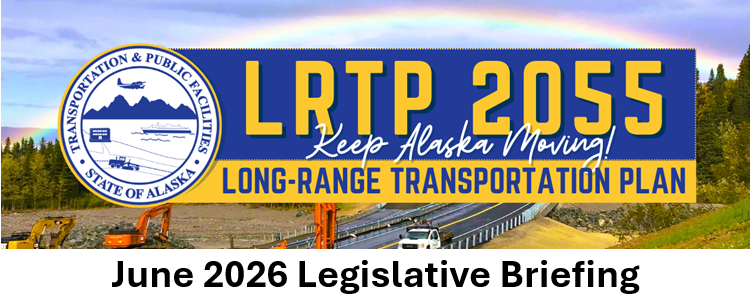
·    Long-Range Transportation Briefing.

·    Oil and Gas Pipeline Topics with Current Topics, Stuff I Found Interesting, Education, Politics, Healthcare

·    Resource Values, Permanent Fund Data


Gasline Finance Committee Meetings


No Meetings to Report


MEMORANDUM     


To: Members of the Alaska State Legislature

From: Alaska Department of Transportation & Public Facilities (DOT&PF)

Date:June 15, 2026

Subject: Alaska Long-Range Transportation Plan 2055 Update


This memorandum provides an update on development of the Alaska Long-Range Transportation Plan (LRTP) 2055, including the purpose of the plan, current planning activities, and major transportation issues affecting Alaska’s statewide transportation system.

The LRTP is Alaska’s federally required statewide transportation plan prepared under 23 U.S.C. §135 and 23 CFR 450.216, along with associated state planning requirements under 17 AAC 05.120–150. The plan establishes a long-term policy framework guiding statewide transportation planning, coordination, and investment decisions over the next 30 years.

Overview of the LRTP

The Alaska LRTP 2055 updates the State’s previous long-range plan, “Let’s Keep Moving 2036,” adopted in 2016. The updated plan is being developed to guide planning and programming decisions for Alaska’s multimodal transportation system through 2055. The plan addresses highways, aviation, marine transportation, transit, rail, freight systems, and active transportation facilities, while supporting coordination among state, federal, regional, tribal, and local partners.

The Alaska LRTP 2055 itself does not authorize projects or appropriations. Instead, it establishes statewide transportation goals, policy direction, and investment priorities intended to support future capital programming and system management decisions.

Transportation remains fundamental to Alaska’s economy and quality of life. Alaska’s transportation network supports freight movement, tourism, military operations, emergency response, subsistence access, and community connectivity across a geographically large and diverse state. Alaska’s transportation system includes approximately 17,654 miles of roads and highways, 285 airports, 39 ferry terminals, 149 harbors, and more than 1,000 bridges. More than 80 percent of Alaska communities are not connected to the road system and rely heavily on aviation and marine transportation for access to goods, services, and economic opportunities.


Current Status of ALASKA LRTP 2055 Development

DOT&PF is currently developing the Alaska LRTP 2055 through a statewide planning process that includes technical analysis, agency coordination, stakeholder engagement, and public outreach. Initial phases of work have focused on evaluating current transportation system conditions, infrastructure performance, demographic and economic trends, freight movement, climate impacts, and emerging technologies.

A Transportation Assessment Technical Memorandum was recently completed to document existing conditions and identify major transportation trends, risks, and opportunities likely to shape Alaska’s transportation system over the coming decades. The assessment emphasizes Alaska’s dependence on multimodal transportation connectivity and highlights the challenges associated with aging infrastructure, geographic isolation, climate-related impacts, and long-term funding needs.

The planning effort also includes public outreach and stakeholder coordination with Metropolitan Planning Organizations (MPOs), Regional Planning Organizations (RPOs), tribal governments, local governments, transportation providers, industry stakeholders, and the public. Outreach activities have included public meetings, virtual engagement opportunities, surveys, and collection of “User Stories” describing transportation challenges and experiences from communities across the state.


Major Transportation Issues

Several long-term transportation issues are shaping development of the Alaska LRTP 2055. These include the preservation and maintenance of aging transportation infrastructure, increasing costs associated with construction and operations, and continued reliance on federal transportation funding. Rural accessibility and freight reliability remain significant statewide concerns, particularly in communities dependent on aviation and marine transportation.

The planning effort is also evaluating the effects of climate change and environmental conditions on transportation infrastructure. Permafrost degradation, flooding, coastal erosion, landslides, severe storms, and other natural hazards are increasingly affecting transportation system reliability and long-term infrastructure resiliency.

In addition, the LRTP is considering the role of emerging technologies and data-driven transportation management systems, including intelligent transportation systems, unmanned aircraft systems, broadband integration, and electric vehicle infrastructure.

Consistent with federal requirements, the LRTP is being developed using a performance-based planning approach that incorporates statewide transportation performance measures related to safety, infrastructure condition, mobility, freight movement, and system reliability.

Next Steps

The next phase of the Alaska LRTP 2055 process will focus on development of statewide transportation goals, performance measures, policy recommendations, and implementation strategies. Additional public and stakeholder outreach will occur as draft plan materials are prepared for public review on the plan website: https://publicinput.com/alaskaLRTP2055.

DOT&PF anticipates continued coordination with the Legislature as development of the Alaska LRTP 2055 progresses toward completion and adoption, anticipated for December 2026.

Conclusion

The Alaska LRTP 2055 provides an opportunity to establish a coordinated long-term vision for Alaska’s transportation system while addressing statewide infrastructure needs, economic priorities, system resiliency, and multimodal connectivity. The plan is intended to support informed transportation policy and investment decisions that will help maintain safe, reliable, and efficient transportation access for Alaska’s communities, businesses, and industries over the coming decades.


Oil and Gas Pipeline Topics

Alaska natural gas pipeline dreams stretch over half a century Alaska Beacon

The president of the United States urged lawmakers to do everything they can to make the long-desired Alaska natural gas pipeline a reality. “It is in the national interest to bring Alaskan gas reserves to market at the lowest possible price for consumers,” the president said in an official message. “Every effort must be made to ensure timely completion of the pipeline at the lowest possible cost consistent with Federal regulatory policies.” The president was Jimmy Carter. The year was 1979.


Senators weigh risk of gas pipeline project as special session deadline approaches Alaska Public Media

The Department of Revenue told senators Monday the tax breaks currently under consideration represent an approximately 89% reduction from the property tax currently on the books — and a 96% cut for the first phase of the project, which would deliver gas from the North Slope to Southcentral Alaska for in-state use.


‘A moving target’: Senate members race to finalize Alaska LNG tax breaks as session deadline looms Anchorage Daily News

Senate members have three options: approve a House-passed tax structure with no changes, granting billions of dollars in subsidies to the developers of the long-envisioned project; make changes to the House bill over the objections of Gov. Mike Dunleavy and New York-based project developer Glenfarne; or pass nothing at all before the special session ends Friday.

(My comment: Go to the end of this well-written article to see the bills before the Governor. He can veto any of these. He could allow them to become law without his signature. He could sign his name to them.)


Opinion: We develop our resources for the people, not the developer Anchorage Daily News

Article VIII was the first article ever written into a state constitution to deal solely with natural resources. Fifty-five delegates drafted it in Fairbanks in 1955 and 1956. Section 2 reads: “The legislature shall provide for the utilization, development, and conservation of all natural resources belonging to the State, including land and waters, for the maximum benefit of its people.”

For the maximum benefit of its people. Not for the developer’s maximum benefit. Not for the maximum benefit of a New York investment firm. For the people. The delegates who wrote those words knew what they were doing. Alaska had spent decades watching outside commercial interests extract its resources while Alaskans bore the costs and saw little of the return. The fish trap was the symbol of that era — Outside-owned canneries hauling salmon out of Alaska’s waters while local fishermen struggled to make a living. Territorial Gov. Ernest Gruening called it exploitation by absentee interests.


Opinion: Jobs will flow before natural gas does, so let’s get the pipeline started today Anchorage Daily News


Opinion: Passing Alaska gas line legislation is no laughing matter Anchorage Daily News

An opportunity to create an estimated 10,000 jobs for Alaskans. An opportunity to export Alaska’s abundant natural gas to markets across the Pacific Rim. An opportunity to provide affordable, reliable energy to Alaska homes and businesses at a time when Southcentral Alaska faces growing concerns about future gas supplies.

(My comment: NONE of this is GUARANTEED. The numbers don’t support these assertions or dreamy wishes. Glenfarne doesn’ty have the pipe purchased, there are no investors to pay the bills, they don’t even have the full right-of-way to build the pipeline on.)


Opinion: Glenfarne’s Alaska LNG numbers still don’t add up Anchorage Daily News

Glenfarne subsequently offered an updated estimate of between $13.2 billion and $16.9 billion for the in-state pipeline, and $44.5 billion to $54.5 billion for the entire export project. The economics of Alaska LNG do not work as just an in-state pipeline, which makes the overall cost of the Nikiski liquefaction and North Slope gas treatment facilities a crucial figure. 


Opinion: Alaska workers built this state. Now we’re building its future Anchorage Daily News

When Alaska LNG breaks ground, workers on the front line will be Alaskans. The memorandum of understanding recently executed between Glenfarne and the Alaska building trades councils is a legally binding document that sets the foundation for full project labor agreements covering everything from LNG export facilities and gas treatment plants to compressor stations, camp construction and road work, stretching more than 800 miles across our state.

(My comment: Months ago, Glenfarne signed Project Labor Agreements with Lower 48 unions. These are the specialized groups that know how to do the critical work on the pipeline. I am very skeptical that Alaskans will get even 50% of the jobs (which is what the FERC document submitted by Glenfarne says).)


For trans-Alaska gas pipeline operator, carbon dioxide may be a lucrative sideline Alaska Beacon

Carbon dioxide, a byproduct of the proposed trans-Alaska natural gas pipeline project, could net the pipeline’s operators more than $285 million per year from the federal government, the Alaska Department of Revenue estimates in a forecast released this month

(My comment: This 45Q tax credit benefit is huge for Glenfarne, who would be the owner of a Gas Treatment Plant on the North Slope. Before natural gas could be put into a gas pipeline, CO2 and other elements must be removed. Sequestration, or burying, the CO2 underground would earn the producer $85/tonne if they are an oil producer, or $135/tonne if they own the GTP. This is lots of money which the State would receive none of.)


Gas pipeline deadlock continues in Alaska Senate as special session nears end Alaska Beacon

Under current law, the pipeline would generate $47 billion for the state and boroughs along the route through 2062, according to figures from the Alaska Department of Revenue. The House-passed bill would drop that figure to about $31 billion. The $16 billion difference is the result of the switch from a property tax to a gas tax. The state would still collect production taxes, royalties and other fees.


Economy

New majority: 2 working parents Axios

A majority of U.S. families (52%) now have two parents who work full-time — a record high, Axios' Avery Lotz writes from a new Pew report. That's up six points from a decade ago and 21 points since 1975. The share of families in which the dad works full-time and the mom is not employed fell from 42% in 1975 to just 23% last year.


Education

Alaska districts close 12 schools this year, amid severe budget cuts Alaska Beacon

Alaska saw an unprecedented wave of school closures this year. District officials grappling with severe budget shortfalls have opted to close 12 elementary and middle schools across the state — in Anchorage, Wasilla, Sutton, Seward, Sterling, Soldotna, Kasilof and Ketchikan. With those closures, hundreds of students and staff will bus or commute to new schools next year, class sizes will grow as grades are combined and districts across the state are cutting programs, teachers, health aides, custodians, sports, library services and extracurriculars like music. 


Alaska Resource Values


Alaska North Slope crude oil price (06/16/2026): $89.69

FY26 budget (beginning 7/1/25) is fully funded at

$64/barrel of oil.


Cook Inlet Prevailing Value (2026 Q2): $8.73 ($ per MCF)


History of prices:

3/23/2026: $101.05 (Iran War)

12/17/25: $60.06

9/20/24: $63.63

9/30/23: $87.99

9/30/22: $86.91

6/29/22: $116.84

3/08/22: $125.44

12/22/21: $75.55

March 2020: $12.29 (COVID)

7/3/2008: $144.00

ANS production (6/16/26):458,935 bpd


Precious Metal Prices

June 18, 2026

Gold - $4198.33

Silver - $65.75

Platinum - $1687.50

Copper - $6.34

Palladium - $1295.12

Rhodium - $8000.00


Alaska Permanent Fund

website

How is the Fund invested? Alaska Senate Finance Committee, presenters: Callan, Investment Advisors. Callan said that APF is "one of the best run portfolios among our clients".

February 25, 2026 Link to meetingMeeting Notes.


Fund value June 18, 2026 - $88,700,400,000


PFD payout from ERA, Fiscal years 1982-2025: about $31.3 billion

Over $100 billion total earnings over lifetime of the Permanent Fund


Feedback is always welcome.

Have a great week!


Cathy 


Personal Contact:

907.465.4843

sen.cathy.giessel@akleg.gov


Past Newsletters on my website


My Staff:

·    Chief of Staff: Jane Conway (from Soldotna)

·    Resources Committee Staff: Paige Brown (from Anchorage/Girdwood)

·    Office Manager: Samantha Freeborn (from Anchorage)


Copyright © 2026. All Rights Reserved.


Senator Cathy Giessel's Newsletter | 12701 Ridgewood Rd | Anchorage, AK 99516 US