|
Dear friends and
neighbors,
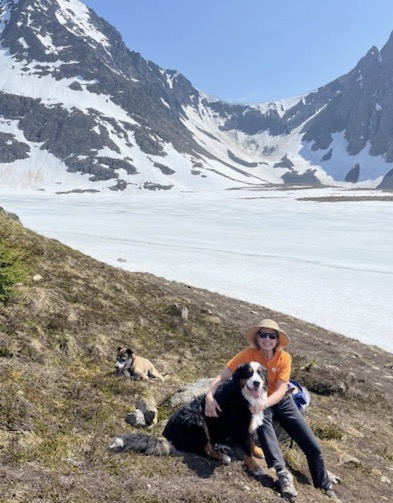
It's so great to get out
in our trails, lakes, and rivers on these sunny days! Fortunately
one of the sunny days was on Juneteenth holiday. (Photo: Rabbit
Lake with my 2 fur children.)
I join you in hoping for
a sunny (at least not rainy) Independence Day Weekend! Be safe!
Three items to update you on:
1. Special Session
2. Governor response to Legislation
3. Issues in H.R.1 in Congress
1.Special Session called by Governor Dunleavy, August 2.
See
the proclamation here.
Dunleavy
calls August special session to address education, agriculture. ADN
What are the implications
of a special session?
One Senator and probably
other Legislators will not be able to attend on August 2. That
means Legislators may not be present at a joint session to address
overriding Governor vetoes. The Constitution requires the vote to
take place in the first 5 days of a session; the
Constitution also requires a 3/4 vote (45 votes out of 60) to
override a veto.
If no override vote takes
place in the first 5 days, or if 45 votes to override are not made,
the vetoes become securely in place.
The Governor vetoed education
funding down to a number below what its been for several years,
something never before done. His policies requirments would cripple
free public education, in favor of private and charter schools. The
Dept of Agriculture (SB 128) would cost about $7 million to
just begin its formation; added costs would come as divisions were
created. The Governor vetoed the funding for costs of a special
session that the Legislature put in the budget.
Other vetoes were made in
the budget in nearly all departments for things like road
maintenance, child care, chronic disease prevention, medicaid
services, etc. These were all in my last newsletter.
Vetoed legislation listed
in Item #2 and further in this newsletter would all be eligible for
veto overrides by the Legislature. But members must be present to
achieve 3/4 vote (45) threshold.
The two items on the
"special session call" are issues that were exhaustively
addressed between January-May of 2025. Education policy agreed to
by the Legislature was vetoed by the Governor. The Dept of
Agriculture was rejected by the Legislature due to the high cost
and vague proposals to pay for a new department.
These items have been
deliberated by the Legislature during the session. The Governor did
not engage in any of the discussions and was rarely present in
Juneau during the entire session.
2.Governor's Response to Legislation
This is a new section
added further on in this newslsetter so that you could see what
happened to a bill that you might be interested in. Scroll down
in this newsletter to see the list of vetoed bills.
One veto action stands
out: Lawmakers
plan to issue subpoenas over Dunleavy veto of oil tax audit. Alaska's News Source
Lawmakers plan to issue
subpoenas over Gov. Mike Dunleavy’s veto of SB
183 -
a bill supporters say was necessary to force his administration to
reveal oil/gas tax audit results. These tax settlement
amounts have dropped dramatically during this governorship. So
when the Dept of Revenue refuses to put the data into usable form,
the State Auditor began to make multiple requests, when denied
brought it to the Legislature's attention. The Speaker of the House
and Senate President made the request for usable data, which was
also denied by the Governor himself. The missing revenue isn't just
$50; its a reduction in tax audit findings of more like $50
million.
3.Issues in H.R. 1 Bill
in Congress
Speaker of the Alaska
House, Bryce Edgmon, and I coauthored an opinion piece in the New
York Times that printed on June 27.
Alaska
Cannot Survive this Bill New York Times
Because of NYT policy, I
cannot provide you with a reprint of the opinion piece but here's a
summary of elements we covered:
We outlined the impact
that the reduction of Federal support for Alaska Medicaid will have
on our people, communities, and economy. We point out that nearly
40,000 Alaskans losing healthcare coverage, thousands of families
going hungry through loss of SNAP benefits, and a cost shift that
will throw Alaska’s budget into a severe fiscal deficit, crippling
our state economy and making it harder for Alaska to provide basic
services.
In remote Arctic
communities, Medicaid dollars make medical travel possible for
residents from the hundreds of roadless villages to the communities
where they are able to access proper medical treatments.
SNAP puts food on the
table and is also uniquely used to help purchase subsistence gear
for essential hunting and fishing. The benefits of Medicaid and the
SNAP program permeate the entire fabric of the Alaska economy, with
1 in 3 Alaskans receiving Medicaid support and 70,000 residents
assisted through food stamps.
Food insecurity in our
state is highest in the villages of Western Alaska where residents
depend on subsistence to survive. And at a time when many fish runs
are collapsing due to climate change and Alaskans are months behind
on SNAP benefits, cutting federal funding for SNAP will have a more
profound impact here than in any other state.
A scenario can be
imagined, and could come to fruition, is a village in rural Alaska
losing its one-and-only grocery store due to a drastic decline in
SNAP dollars, and at the same time losing its sole healthcare
clinic or hospital because it cannot sustain its services with
decreased Medicaid reimbursements.
To keep up with rising
energy costs, our Arctic communities have successfully relied on
innovative renewables to cut costs and reduce dependence on
imported diesel fuel for over two decades.
Here
is a comprehensive summary of HR1
This is a long list of
media coverage:
‘One
of the hardest votes’: Murkowski joins Sullivan in voting for
budget bill that includes Medicaid cuts - Anchorage
Daily News
Murkowski
helps win Senate passage of Republican megabill
Facing
SNAP & Medicaid concerns, why Murkowski & Sullivan say they
voted for the ‘Big Beautiful Bill’
Alaska
Republican US Sen. Lisa Murkowski addresses her ‘Yes’ vote on the
big federal budget bill | Alaska
Beacon
Sullivan,
Murkowski vote to pass Senate Republicans’ budget bill, with big
health care cuts looming | Alaska Beacon
House
leadership races toward final vote on Trump’s tax and spending
bill, all but daring GOP critics to oppose it - Anchorage
Daily News
Senate
budget bill speeds phaseout of incentives for solar and wind energy - Anchorage
Daily News
What
the GOP’s tax bill means for your health care - Anchorage
Daily News
Day
camp, summer school and after-school programs in limbo during Trump
administration review - Anchorage
Daily News
To win Sen. Murkowski
support, Republicans leaders made additional last-minute
concessions. The GOP doubled the value of a rural hospital bailout
fund meant to ease the institutions’ adjustment to the Medicaid
cuts. The agriculture portion of the bill delayed implementation of
cuts to SNAP for high-poverty states. And tax-writers removed a
provision that would have imposed a new duty on renewable energy
systems.
“Good things are
important,” Murkowski said, “but it also is important in terms of
how they are paid for, and I struggled mightily with the impact on
the most vulnerable in this country when you look to the Medicaid
and the SNAP provisions.”
My Comment: I continue to oppose the
Medicaid cuts in the Ugly Bill:
The bill passed would
deeply undermine access to mental health and addiction care. As a
nurse practitioner, mental health and addiction services for
Alaskans is one of my top interests. These services address
children and adults, suicide among teens, homelessness...the list
is endless of how important mental health is for a person.
A national mental health
association points out: Mental health isn’t a partisan issue. It’s a public
safety, workforce, and community issue. Medicaid is the largest
funder of mental health and addiction treatment in the country. For
many veterans, people in recovery, first responders, and working
families, it’s the only lifeline available. H.R.1 guts that
lifeline.
If passed by the House,
H.R.1 would:
·
Strip coverage and access
to mental health care from millions
·
Put pressure on law
enforcement, jails, and emergency rooms to respond to crises they
aren’t equipped to handle
·
Force states to either
raise taxes or cut essential services to fill the gap
·
Put community mental health
providers at risk of closure or collapse
Without access to care,
more people will end up on the streets, in jails, or in repeated
crisis.
My Comment on Nuclear
Energy components of H.R.1
I am an advocate of the
small and micro nuclear, advanced technology, reactors. They
represent great opportunity for Alaska, urban and rural, to offset
high cost diesel fuels.
The following includes a
summary of some of the provisions in H.R.1:
·
$125 million “… the
acceleration of development of small, portable modular nuclear
reactors for military use”;
·
funding totaling almost
$4 billion for infrastructure modernization. These amounts are
in addition to annual appropriations. Note the fuel
reprocessing funding is in the Bill.
|