Senate Majority Bipartisan Coalition Website

State Senator District E

Senate Majority Leader


Senator Cathy Giessel Newsletter

UPDATES


Issues affecting

your family, community and jobs.


December 11, 2025


Dear friends and neighbors,


Legislative stuff ramping up so this is going back to weekly newsletter, to keep you informed.


We expect the Governor's Fiscal Year 2027 Budget to be released today (12/11) or Friday (12/12). So watch for that.


Why aren't Alaska Teachers getting Social Security?

Readers of last week's newsletter are asking this question, after reading last week's piece on HB 78 (proposed new Pension system).


Here's the answer:

This is the history of Alaska Teacher Social Security, from the State of Alaska Division of Retirement and Benefits. (Not that the website is not updated re: WEP and GPO)

In short, it says:

When the federal Social Security Act (Act) was enacted in 1935, public employees were not eligible for Social Security benefits. This was due to a constitutional question regarding the federal government’s power to tax state and local governments. Consequently, many government employees were without a retirement plan.

When Section 218 of the Act authorized states to voluntarily elect Social Security coverage for public employees in 1951, existing retirement systems were excluded by federal law from participation in Section 218 agreements.

The same Section 218 provision that excluded members of the original Anchorage Police and Fire system in 1951 also excluded members of the Teachers’ Retirement System (TRS), since they already had an existing retirement system (Territorial Teachers’ Retirement System, which later became TRS.)

Four years later, in 1955, the Social Security Administration decided to let these excluded systems enroll in Social Security coverage. The Social Security Administration declared that members of an excluded system could hold a vote and elect whether or not they wanted Social Security coverage.


But the vote to join Social Security is not easy.

Here is a legislative memo that I requested.

In short, it says:

It appears possible for a school district to initiate the process of making its teachers eligible to enroll in SS coverage. It is important to emphasize, however, that the process for doing so is complicated and requires close coordination between state and municipal government entities to ensure conformity with federal law. Further, as we discuss in greater detail below, returning teachers to SS would require their approval of the change through one of two available voting regimes. It is unclear to what extent such a vote would be successful given potential reductions to SS benefits caused by provisions in federal law. 


Bottom Line: A teacher in Alaska has only what they have set aside/earned investments from savings or 401(k). Nearly all other states provide teachers with a guaranteed pension retirement and federal social security. See March 2022 summary of data on this.


'A wicked problem': State Board of Education presented with educator turnover rates. Alaska's News Source


Alaska teacher turnover rates have gone up since the pandemic, report finds. Alaska Beacon

Alaska principals and teachers are leaving their jobs more frequently since the COVID-19 pandemic, according to data from researchers at the University of Alaska Anchorage’s Institute for Social and Economic Research.

(Powerpoint of presentation: State board of Ed 12.1.2025 | DocumentCloud)


Upcoming Session

I am preparing to move to Juneau in mid-January.

Session begins on January 20. The first day is usually not any content. We will probably hold a Committee on Committees meeting which will assign new Senators Tilton and Rauscher to committees.


I will start Senate Resources committee meetings on Jan. 21, to continue every M, W, F from 3:30-5. First topic will be the possible gas pipeline.


I will begin State Arctic Affairs on Jan. 22 from 1:30-3.


Committee meeting links will be included each week, so you can listen to recordings of the hearings, and access documents from the meetings.


Governor's FY 2028 Budget to be out by Dec. 15

We know that there will be a supplemental budget (which covers the Administration's items that were insufficiently budgeted for). The Legislature anticipates the supplemental will be in the neighborhood of $200-300 Million. Those items include road maintenance and wildfire response. We are aware that oil price forecasts are for low $60s, even into $50s. The Percent of Market Value (POMV) from the Permanent Fund will distribute $4 Billion this year for spending. (The POMV is the spending cap.)


Alaskan Students Welcome to Apply for 2026 Internships

At the Alaska Permanent Fund Corporation (APFC), managing one of the largest sovereign wealth Funds in the country means thinking long-term about capital, risk, and people. Our internship program reflects the same commitment to Alaskan students, developing leaders to carry Alaska’s financial legacy forward.

At APFC, interns participate in real projects, collaborate across teams, and gain insight into the operations of a globally diversified Fund that manages more than $84 billion on behalf of Alaskans.

Whether analyzing markets, contributing to research, or working closely with our partners, interns gain invaluable exposure to institutional practices, and many stay connected to the Corporation long after the program ends.

Read more HERE


Learn more about the program: Read the Internship Overview

View current internship openings: Go to APFC Careers


Permanent Fund's latest values and earning at end of this newsletter, in Alaska Resources Value section.


Items in this Newsletter:

·    Catch up with Cathy Events

·    Legislative Finance Division Newsletter

·    Seward Highway Re-Design Advisory Committee Update

·    News from Senator Murkowski's Office

·    RDC Breakfast Presentation Recording

·    Current Topics, Stuff I Found Interesting, Arctic Issues, Economy, Education, Politics, Healthcare,

·    Resource Values, Permanent Fund


Catch up with Cathy


These are informal coffee conversations in which the folks that attend determine the topics of interest and concerns.


Last 2025 one:

December 13: 10:30-11:30am

at Bells Nursery Cafe on Specking Road


December 2025 Newsletter

This issue includes updates on state assistance to retirement, the Permanent Fund's FY25 performance, and links to new publications.


FY27 Retirement Contribution Rates

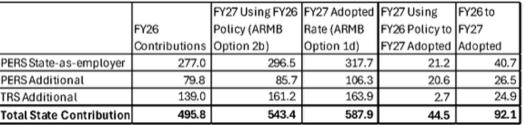
The Alaska Retirement Management Board adopted FY27 contributions rates in its September 17, 2025, meeting that incorporated a significant policy shift. In 2014, the legislature and ARM Board amortized the existing unfunded liability over a 25-year period, which will end in FY39. Beginning in 2018, any additions (or decreases) to the unfunded liability (due to experience gains/losses or changes in assumptions) were then "layered" with new 25-year amortization periods. For FY25 and FY26, the Board adopted rates without layering, meaning that the new liabilities would be paid off by FY39. This year, the ARM Board again changed its policy, retroactively converting all post-2014 changes in unfunded liabilities to a 15-year layered amortization. This has the effect of increasing State contributions from FY27 through FY33 but decreasing them significantly after that, with total State contributions for FY27 through FY39 projected to be lower under 15-year layered amortization. 

(See chart below)


In FY27, the impact of this policy shift is to increase the additional State contribution to TRS (compared to the policy used for the FY26 rate) from $161.2 million to $163.9 million, the additional State contribution to PERS from $85.7 million to $106.3 million, and the State-as-an-employer contribution to PERS (which will be paid with multiple fund sources through agency operations funding) from $296.5 million to $317.7 million. Combined, this change will increase State costs in FY27 by $44.5 million, of which LFD estimates about $33.9 million will be UGF (assuming 50% of the State-as-an-employer cost is paid by non-UGF fund sources). Compared to FY26 rates, the total cost is $92.1 million higher, of which LFD estimates about $71.8 million will be UGF.


FY25 Permanent Fund Performance and FY27 POMV Draw

The Alaska Permanent Fund's total income for FY25 was $7.8 billion. Since this income and royalty income combined to exceed appropriations out of the fund, the Permanent Fund's total balance grew from $80.5 billion at the end of FY24 to $85.1 billion at the end of FY25. 


The FY27 Percent of Market Value (POMV) draw from the Permanent Fund, which is based on the market value from FY21-25, is now set at $3,996.9 million. This figure represents a $198.0 million increase over the FY26 POMV draw. This large increase is due to incorporating the very strong FY21 return fully into the average used for the POMV calculation. 


Statutory net income totaled $5,866.0 million, which resulted in an increase to the realized balance of the Earnings Reserve Account (ERA) from $8.0 billion to $10.2 billion. The legislature repealed the FY25 inflation-proofing transfer to the principal of the Fund and did not appropriate the FY26 transfer. Instead, it designated an additional $4.0 billion transfer from FY20 as inflation-proofing. Cumulatively, LFD estimates that through FY26 (based on a projected 2.5% inflation rate in CY25), appropriated inflation proofing transfers since FY16 are about $373.8 million below the statutory calculation.


LFD Informational Paper 2025-1: Public Assistance Eligibility Staffing

LFD published a new informational paper summarizing the past decade of staffing of the Division of Public Assistance. This is a frequently-requested item due to a complex history of staffing cuts, add-backs, and multi-year appropriations on top of the base budget. This division determines eligibility for Medicaid, SNAP, and other needs-based programs administered by the Department of Health. 


This paper covers the period beginning with Medicaid expansion in FY16 through the present day, and compares the budget, staffing, and Alaska's SNAP error rate and any federal penalties levied on Alaska due to the error rate.


Summary of Appropriations

Earlier this month, LFD published the Summary of Appropriations. This document is a comprehensive record of budget actions made this past session and includes detailed reports, tables, and all the final appropriations bills. This document is primarily intended for historical reference. 


If you'd like to unsubscribe, you can do so here. If this was forwarded to you, you can subscribe using the same link.


Alexei Painter

Legislative Fiscal Analyst

430 Main Street

Juneau, Alaska 99801

(907) 465-3795

http://www.legfin.akleg.gov


Seward Highway Redesign Advisory Committee:


The Advisory Committee met last week. Based on the previous meeting and more discussions, they narrowed down the purposes and needs to four priorities:

1.       Improving pedestrian and bicycle safety, in terms of north-south and east-west connectivity, and intersection safety.

2.       Brayton Drive: speed, access, lack of non-motorized infrastructure, road condition, cut-through traffic

3.       Protect residential communities: discourage motorist cut-through, local connectivity, minimize out of direction travel, emergency service connectivity

4.       Interchange / Highway Safety: short merge lanes, dual left turns are tight, confusion regarding right-of-way on merge ramps, bottlenecks on O’Malley for turning north on Seward Hwy.

They then spent an hour coming up with possible solutions. Staff is going to synthesize these and come back for next week’s meetings with a more focused purposes and needs, and the beginning of planned solutions.


News from Senator Murkowski's office


DOE Critical Minerals NOFOs: On November 14, DOE announced $355 million for two notices of funding opportunities (NOFOs) to expand domestic production of critical minerals. The first funding opportunity provides up to $275 million for industrial facilities capable of producing valuable minerals from existing industrial and coal byproducts. The second funding opportunities provides up to $80 million to establish a testing facility for next-generation mining technologies. 


DOI Critical Minerals List: On November 7, the U.S. Geological Survey published its final 2025 List of Critical Minerals. The final list adds 10 new minerals—boron, copper, lead, metallurgical coal, phosphate, potash, rhenium, silicon, silver, and uranium. The list now contains 60 minerals and can be found here


Constellation Nuclear LPO Loan: On November 18, the Department of Energy’s (DOE) Loan Programs Office (LPO) closed a $1 billion loan to Constellation Energy to help finance the Crane Clean Energy Center, an 835-MW plant on the Susquehanna River in Pennsylvania. 


X-energy Nuclear Fuel Construction: On November 17, X-energy announced the beginning of above-ground building construction for its advanced nuclear fuel fabrication facility in Oak Ridge, Tennessee. This facility will manufacture fuel for advanced Small Modular Reactors (SMRs) and is the first of its kind in the U.S.


Nikolai Nickel FAST-41: On November 19, the Federal Permitting Council added the Nikolai Nickel project to its FAST-41 list of covered projects. The FAST-41 listing will initially focus on rehabilitation and extension of the existing Rainy Creek Mining Trail, including installation of two temporary bridges and an on-site camp. 


WOTUS Definition: On November 17, the U.S. Army Corps of Engineers (USACE) and the Environmental Protection Agency (EPA) released a proposed rule revising the definition of “waters of the United States” (WOTUS) in the Clean Water Act. USACE and EPA are currently soliciting comments on the proposed rule; we encourage Alaskans to take a close look to help make sure it works for our state’s unique needs. 


AKLNG: On November 10, Glenfarne Group, the developer of the Alaska LNG Project (AKLNG), signed a definitive strategic partnership agreement with energy technology company Baker Hughes. Under this agreement, Baker Hughes will supply $1 billion in equipment for the project. On November 19, the Alaska Gasline Development Corporation (AGDC) and Glenfarne briefed the Alaska Legislative Budget and Audit Committee on the AKLNG project alongside energy consulting firm GaffneyCline. The presentation can be viewed here. Glenfarne has also met with the Alaska Workforce Investment Board as part of their outreach efforts. (MY COMMENT: Baker Hughes recently purchased GaffneyCline consulting firm, who is under contract with the Alaska Legislature. Conflict of interest questions exist.)


RDC's Breakfast Presentation Online

The presentation and associated videos are up on our website now!


Topic:

50 Years in Alaska Without TAPS


Presenter:


Dave Norton, P.E., Senior Advisor, Hawk Group

Scott Goldsmith, Economist, UAA ISER (Retired)


Current Topics

Alaska lawmaker questions legality of National Guard-ICE assistance. Alaska News Source

"It’s questionable whether or not it’s even legal.” That legality, Wielechowski said, runs askew to “the prohibition against domestic policing,” or the Posse Comitatus Act.


New Anchorage law protects public access points, concerning some landowners. KTUU


Anchorage can now fine property owners who block access to public land. ADN

Those who obstruct a public right-of-way without a lease or permit would be charged $1 per square foot of property “obstructed or otherwise impeded from public use per day,” according to the ordinance. Depending on how much land is blocked, fines could accumulate over time.


Things That I Found Interesting

Why Main Street's pain matters. Axios

Bloomberg recently reported that there are more small businesses filing for bankruptcy under a special federal program this year than at any point in the program's six-year history. Subchapter V filings, which allow firms to shed debt faster and cheaper, are up 8% from last year, according to data from Epiq Bankruptcy Analytics. Chapter 11 filings — a process used by larger businesses — are up roughly 1% over the same time frame. Main Street is bearing the brunt of an economic slowdown in ways that might make it even harder for small shops to compete with larger companies.


Opinion: Rethinking Alaska's state seal for the modern era. ADN


Economy

New poll: Gen Z's dark fears. Axios

Financial insecurity, intense political polarization and the rise of AI are eroding Gen Z's faith in their economic prospects and public institutions overall.

A majority of respondents (57%) say the country is headed in the wrong direction — a six-point rise from last year.


Babies are basically getting 401(k)s now. Axios

This "shareholder economy" has been a long time in the making, as policymakers and businesses gradually shift responsibility for major social safety net policies onto individuals.

(My comment: 401(k)s are great for the financially literate and those who only hold one job and have leisure time to follow the stocks. For people who are single parents, hold more than one job to make ends meet, lack the information needed to “play the markets” - this is potentially worse than a savings account, as it can lose money. A savings account at least makes a small interest earning.)


Inflation expectations hold steady, but financial situations worsen. Axios

The New York Fed said that perceptions about households' financial situations relative to a year ago "deteriorated notably," with a larger share of Americans saying they were worse off than this time last year. Compared to the prior month, fewer households said they expect to be better off a year from now. That came as consumers reported they expect the biggest year-ahead spike in medical care costs, up 0.7 percentage point to 10.1%, since 2014 as health care subsidies are poised to expire.


Energy Resources

Opinion: The pipeline that stole Christmas: Why Alaska can’t afford this costly project ADN


Copper has turned into the new digital gold. Axios

Copper prices have been on a tear, rising to record highs, spurred by supply disruptions and worries over Trump's tariffs. When it comes to the digital economy, copper is a precious metal vital for computer chips, EVs, data centers and just about everything that is electrified.


Opinion: Why transmission is Alaska's next big energy project. ADN

No matter what kind of energy we produce — natural gas, hydro, wind, solar or other legacy fuels — it is only as useful as our ability to deliver it where it is needed. The electricity we consume relies on the substations and distribution lines in our neighborhoods which is in turn dependent on high-voltage transmission infrastructure — the backbone of every electric grid. Any path forward for Alaska’s energy future depends on strengthening this backbone.


Louisiana is being urged to lock in its hydrogen future. Business Report

After a year of study, the group has adopted its final report, calling for a permanent clean hydrogen coordinating committee to streamline permitting, workforce development, environmental oversight and economic development strategy. The report also recommends boosting staffing at the Department of Conservation and Energy and the Department of Environmental Quality so regulators can process hydrogen and carbon capture projects faster without sacrificing monitoring and enforcement.


Nuclear, natural gas power generation planned for massive New Mexico Data Center site. Power Magazine

A Texas-based developer and operator of next-generation digital infrastructure and integrated power assets announced it has entered into a land option purchase agreement for a site in New Mexico that would feature a vast data center center campus. The plan announced November 6 calls for more than 2 GW of natural gas-fired generation capacity, and 5 GW or more of nuclear power, to energize the 3,500-acre site.


ConocoPhillips confirms up to 12.5% North Slope layoffs as workers seek union. Alaska's News Source

ConocoPhillips has laid off 10 to 12.5 percent of its North Slope workforce, the company confirmed Tuesday, as employees at three oil fields move to form a union.

(My comment: These are high paying jobs. But my question is: how many of these workers live in Alaska? The North Slope has high percentage of out-of-state workers who fly in for the jobs, taking wages back to other states (where they pay income taxes, property taxes, school taxes, sales taxes, etc to enrich the other state.)


Education

How to weigh in on the University of Alaska's presidential search. Alaska Public Media

The University of Alaska will host listening sessions in Juneau, Fairbanks and Anchorage this week as it ramps up its search for its next president. The sessions follow last month's announcement that UA President Pat Pitney plans to retire this spring. UA has hired the executive search firm Witt Kieffer to help with the process. During the sessions, the university says it hopes to hear what qualities students, staff and community members want in a new leader.


New data shows teacher and principal turnover in Alaska continuing to rise. Alaska Public Media

According to a University of Alaska report to the state Legislature, teacher turnover rates statewide sat above the national average between 2012 and 2021. High turnover is associated with negative student outcomes. DeFeo said in an interview with KTOO on Thursday that her team plans on surveying teachers in February to see which factors play into their decisions to leave.


Politics

Republicans left tribes out of their $50B rural fund. Now it's up to states to share. Alaska Beacon

The Trump administration is touting its $50 billion Rural Health Transformation Program as the largest-ever U.S. investment in rural health care. But the government made minimal mention of Native American tribes in sparsely populated areas and in need of significant improvements to health care access.


Alaska Division of Elections asking for public's help in cleaning up voter rolls. KTUU

The Alaska Division of Elections is sending out a flyer called the “voter registration confirmation notice,” which helps the state determine where voters are. The annual process is a maintenance process where the state sends out one flyer to determine if a voter is still active at a residence.


Ranked choice voting outperforms the winner-take-all system used to elect nearly every US politician. Alaska Beacon

Plurality voting is notorious for producing winners without majority support in races that have more than two candidates. It can also create spoilers, or losing candidates whose presence in a race alters the outcome, as Ralph Nader’s did in the 2000 presidential election. And it can result in vote-splitting, where similar candidates divide support, paving the way for a less popular winner. This happened in the 2016 Republican primaries when Marco Rubio, Ted Cruz and John Kasich split the anti-Donald Trump vote.


Mat-Su Republicans suggest six candidates for two spots in Alaska House of Representatives. Alaska Beacon

Mat-Su Republicans forward candidate names to Dunleavy for filling 2 House vacancies. ADN

Local Republican Party officials delivered their suggestions to replace Cathy Tilton and George Rauscher, whom Gov. Mike Dunleavy appointed to fill two vacancies in the Alaska Senate.


Anchorage Mayor LaFrance defends proposed sales tax during State of the City address. ADN

While some residents have labeled her sales tax proposal as regressive, Anchorage Mayor Suzanne LaFrance used her annual State of the City address to present it as a necessity.

“The municipality can’t afford to provide the same level of services or tackle our community’s needs and challenges — such as outmigration, housing, child care and economic growth — without investment," she said Monday at the Anchorage Chamber of Commerce’s ”Make it Monday" forum at the Dena’ina Center.

(My comment: I agree with Mayor LaFrance! Alaska has not, as a state, invested in itself. So we are where we are – shrinking population, 24% of working people don’t live here (fly-ins), professionals leaving, etc).


Health Care

FDA hits "tipping point". Axios

Another abrupt departure of a high-ranking FDA official is raising alarm about a brain drain that could mean new drugs take longer to reach the public. Biotech and pharmaceutical companies rely on the FDA for dependable guidance as they spend huge sums developing new treatments. The American public needs the agency to ensure treatments are safe and effective.


SNAP backlog stubbornly persists for thousands of Alaskans, and the federal shutdown added to challenges. ADN

The Alaska Division of Public Assistance is continuing to lag in processing food assistance requests on time, new data reveals, amid a federal shutdown and other factors that complicated the application review process in recent weeks.


Steep increases in ACA premiums hit Alaskans. Senior Voice


Hepatitis vaccines credited as life-saving for Alaska children may be upended. Alaska Beacon

Western Alaska, where almost all the residents are Indigenous, used to have the world’s highest rate of childhood liver cancer caused by Hepatitis B. After decades of screenings and vaccinations, that problem has been eliminated; since 1995, only one person under the age of 30 has been diagnosed with hepatitis-caused cancer. Now the Trump administration is seeking to end one of the key tools credited with accomplishing that goal: Hepatitis B vaccinations of newborns.


Alaska settles two lawsuits against vape companies for allegedly targeting kids for addiction. Alaska Beacon

The suits were part of a nationwide pattern: Alaska and other U.S. states had alleged that the companies deliberately targeted children with advertising, something that likely contributed to a surge in nicotine use among children and young adults. Altria settled Alaska’s lawsuit for $2 million last year, and the state announced a $5.8 million consent judgment with Juul.


Rural America relies on foreign doctors. Trump's visa fee shuts them out. ADN

The Trump administration demanded that companies pay a $100,000 visa fee to bring highly skilled workers from abroad, including doctors and medical professionals urgently needed in health care deserts. Nephrology Associates of the Carolinas could no longer afford to sponsor the Indian kidney specialist, and it has not found an American well suited for the job.


Alaska History

·    Dec. 14 - Hanukkah begins

·    Dec. 21 - Winter Solstice

·    Fairbanks - 3 hours, 42 min

·    Anchorage - 5 hours, 23 min

·    Juneau - 6 hours, 21 min

·    Utqiagvik - zero hours

·    Dec. 22 - Last day of Hanukkah

·    Dec. 25 - Christmas


·    1951, Dec. 10 - Anchorage International Airport opened

·    1951, Dec. 11 - first commercial flight over North Pole from Fairbanks, by Alaska Airlines

·    1971, Dec. 17 - Alaska Native Claims Settlement Act

·    1989, Dec. 14 - Mt Redoubt eruptions began


Alaska Resource Values


Alaska North Slope crude oil price (12/9/25): $63.16

FY26 budget (beginning 7/1) is fully funded at

$64/barrel of oil.


History of prices:

10/16/25: $63.17

9/2024: $63.63

9/30/23: $87.99

9/30/22: $86.91

6/29/22: $116.84

3/08/22: $125.44

12/22/21: $75.55

March 2020: $12.29

7/3/2008: $144.00

ANS production (12/9/25): 477,620 bpd


Copper has turned into the new digital gold. Axios

Copper prices have been on a tear, rising to record highs, spurred by supply disruptions and worries over Trump's tariffs. When it comes to the digital economy, copper is a precious metal vital for computer chips, EVs, data centers and just about everything that is electrified.


Norway Sovereign Strategies:$2T Fund, Alaska World Affairs Council

With Alaska’s Permanent Fund as one of the state’s most valuable legacies, what insights can we gain from the world’s largest sovereign wealth fund—Norway’s $2 trillion Government Pension Fund Global? Norway manages its vast oil wealth to balance present needs with future prosperity—and what lessons Alaska might draw for its own Permanent Fund.


Precious Metal Prices

December 10, 2025

Gold - $4251.70

Silver - $63.04

Platinum - $1680.65

Palladium - $1510.50

Rhodium - $7975.00


Alaska Permanent Fund

website

The projected payment to the state General Fund for upcoming Fiscal Year 2027, under the Percent-of-Market-Value (POMV) formula, is to be $4 billion, up from $3.8 billion for FY 2025, the current year.


The Fund’s rate of return over five years has been 9.54%

• For the first three months of the FY 2026 fiscal year, or July 1 through September 30, the Fund had $2.21 billion in “statutory net income.” 


Fund value December 8, 2025 - $87,302,700,000

PFD payout from ERA, Fiscal years 1982-2025: about $33 billion

Over $100 billion total earnings over lifetime of the Permanent Fund


Feedback is always welcome.

Have a great week!


Cathy 


Personal Contact:

907.465.4843

sen.cathy.giessel@akleg.gov


Past Newsletters on my website


My Staff:

·    Chief of Staff: Jane Conway (from Soldotna)

·    Legislation Aide: Paige Brown (from Anchorage/Girdwood)

·    Resources Committee Staff: Inti Harbison (from Anchorage)


Copyright © 2025. All Rights Reserved.


Senator Cathy Giessel's Newsletter | 12701 Ridgewood Rd | Anchorage, AK 99516 US