|
Dear Neighbors,
The legislative session has been especially busy this year. Because this is the last year of the current Governor Dunleavy administration and there are at least 18 candidates running for Governor, the temperature seems to have risen quickly here. The Governor of the State of Alaska has more powers than any other executive in the country because of the drafting of the Constitution. However, the ‘peoples chamber’ is one of the most important because it is the closest to the people in a republic. We write laws, amend the budget and also hold the administration accountable through a system of checks and balances. The third branch of government is the judiciary and this week we heard from the Supreme Court Chief Justice Sue Carney who is from Fairbanks via Boston. The three branches work cooperatively to make it a safer, stronger and more prosperous state for all Alaskans.
| |
Alaska Troop Deployment Cancelled
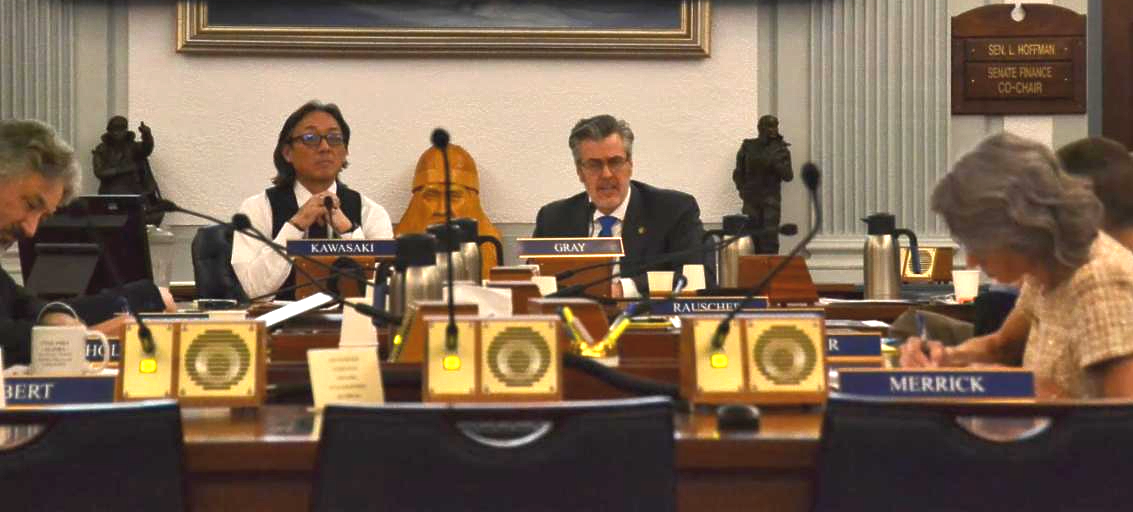
On February 11, the Joint Armed Services Committee convened for a robust discussion on how both Alaska National Guard and active-duty troops are being utilized by the federal government. While the deployment of these troops is within the purview of the federal government, as was pointed out by Representative Nelson during the hearing, both my Co-Chair, Representative Gray, and I were concerned by the “ready to deploy” orders that the 11th Airborne Division received on January 18 of this year. While these orders had fortunately been rescinded by the time we held the formal committee hearing, we felt that the people of Alaska still deserved explanations for the unusual orders to deploy active-duty military personnel domestically to Minnesota.
Professor Dan Maurer, an Associate Professor of Law at Ohio Northern University was invited to comment on the legality of the “ready to deploy” orders. The testimony also included a deep dive into the laws that govern military deployment. The Posse Comitatus Act, U.S Code Titles 32 and 10 and the Insurrection Act of 1807 were discussed in detail. The Posse Comitatus Act was enacted in 1878 to prevent military troops from acting as a domestic police force. Though that act can be overridden if the President enacts the Insurrection Act of 1807. Professor Maurer noted that the Insurrection Act of 1807 contains vague definitions that the President can interpret to enforce it. In the end, he noted that the “ready to deploy” orders were legal, even if the President decided to change the location of the orders after they were issued. (Some experts in the defense community hypothesized the “ready to deploy” orders to Minnesota were a smokescreen to send the 11th Airborne to Greenland.) Professor Maurer’s testimony emphasized the President's authority as Commander-in-Chief over our military personnel.
Margaret Stock, who is a lawyer and retired Lieutenant Colonel in the Military Police U.S. Army Reserve. She spoke about the civil disturbance procedures that army personnel are trained to follow in the US Army Field Manual FM 3-19.15. Her expertise was crucial, as she noted that army personnel are sworn to protect the Constitution, including the right to protest. She testified that her training emphasized open communication between protesters and the troops monitoring them to ensure that the right to protest is protected, not quelled by the military. She emphasized that while officers receive more training on the legality of orders, enlisted personnel are also trained on the concept. It is the duty of each soldier to follow only lawful orders. She further stated the ICE maneuver reported in Minnesota did not match the training she received in handling civil disturbances.
Lisa Slaba testified on how these orders affected the families of the 11th Airborne Division. She asserted that uncertainty is built into the military family model. At any moment, a loved one can be deployed across the globe. The committee appreciated her candor and unique family perspective, which are often overlooked when discussing the military.
While the JASC members were gathered, we also took the time to receive a briefing on the Alaska Defense Forum, held in Fairbanks every year. Brittany Smart, the event organizer, emphasized its importance in bringing together the Defense Community to learn from one another, brainstorm solutions, and build critical connections. I attended the forum last year and plan to return next year. The committee also received a briefing on legislative priorities from Tammie Perreault, a DoD liaison. Her presentation was instrumental for JASC to understand what our members can do to further support military families in Alaska.
| |
Alaskan Wages are Going To Out Of State Workers
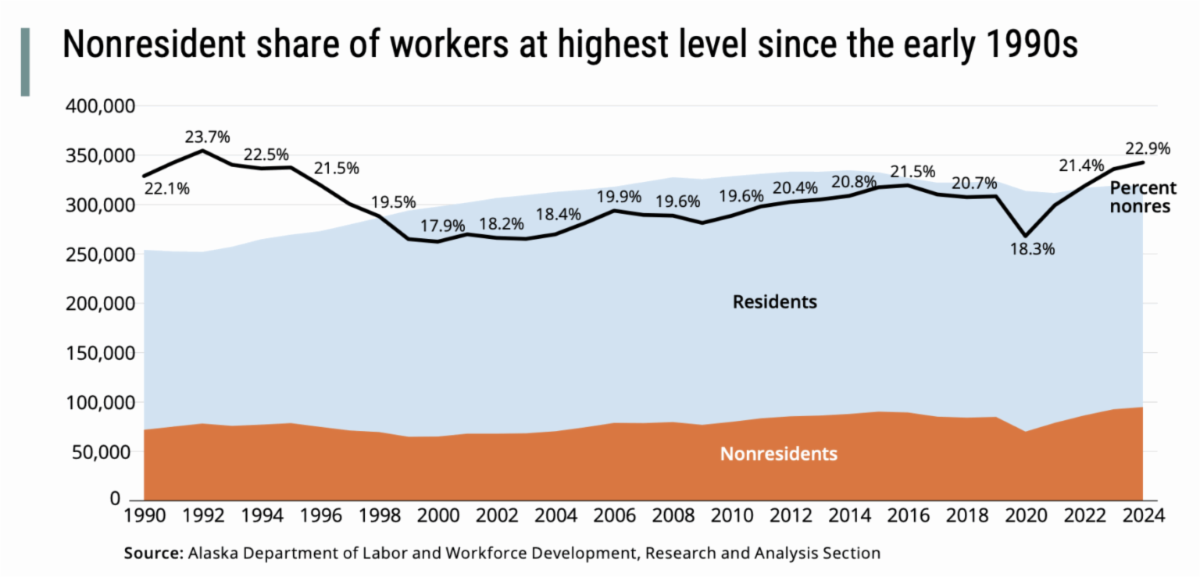
Alaska Department of Labor (DOL) revealed a growing, troubling trend this month. Nonresidents now hold 23% of all non-federal jobs in Alaska, approaching a record high. This indicates a widening gap between the industrial activity of the state and the health of the local economy. In 2024, out of state workers earned almost $4 billion in wages. Unlike wages earned by Alaskans, most of this money leaves the state rather than supporting the local economy, through taxes, buying from small business and paying for goods and services at home.
Resource extraction industries, especially oil and gas, are central to this issue. Despite assurances made during the passage of SB21, recent data show these industries increasingly rely on nonresident labor.
- Oil and Gas: Nonresidents now hold 40.5% of jobs!
- Mining: Nonresidents now hold 44.2% of jobs!
Although these industries received tax incentives to encourage investment and local hiring, the workforce is increasingly composed of nonresidents who commute in and out. When nearly half of the industry workers live outside Alaska, the state loses both labor and the broader economic benefits of stable, resident driven growth. When $4 billion leaves our economy, the tax burden is placed on the Alaskans who remain. We get fewer small businesses and less support for local schools. Addressing hiring local workers is a necessity for a sustainable future.
| |
AK LNG Deserves a Little Transparency
The Natural Gas Pipeline proposed under SB138 continues to be one of the most consequential issues this session. If executed correctly, this project represents a rare chance to responsibly develop natural resources of Alaska to help solve the current fiscal crisis, provide employment opportunities and lower energy costs. However, the scale and complexity of this project demand careful consideration to ensure we fulfill our constitutional duty to maximize the use of Alaska’s natural resources for the maximum benefit of the Alaskan people.
Achieving this is challenging without significantly increased transparency from the companies seeking to develop the resource. The LNG project is being advanced by Glenfarne LLC and the State of Alaska through the Alaska Gasline Development Corporation (AGDC). Yet fundamental details, including the price to consumers, have not yet been provided by Glenfarne or AGDC. Project cost estimates have fluctuated substantially since the plan’s inception. This puts the legislature in the difficult position of negotiating a deal without access to core project details. Obtaining this fundamental information is a prerequisite for the State to navigate negotiations with the confidence necessary to derive maximum benefits from the resource for the Alaskan people.
As currently envisioned, this project does not clearly address the energy needs of Fairbanks residents. Without a spur line, Fairbanks may have limited economic benefits, and fewer opportunities for local energy cost relief. Moreover, if a spur were pursued after tariff structures are established, Fairbanks could have limited influence in the pricing negotiations. SB114 sponsored by Senator Cronk and Senator Myers seeks to remedy this omission by including a spur line to Fairbanks in SB138.
While the AK LNG presents an exciting opportunity, the strongest version of this project is one negotiated on a solid base of information and transparency that directly serves the people of Fairbanks. I will continue my work on the Senate Resources Committee to ensure that the legislature gets the information it needs and the needs of all Alaskans are considered.
| | |
Education is the #1 Priority
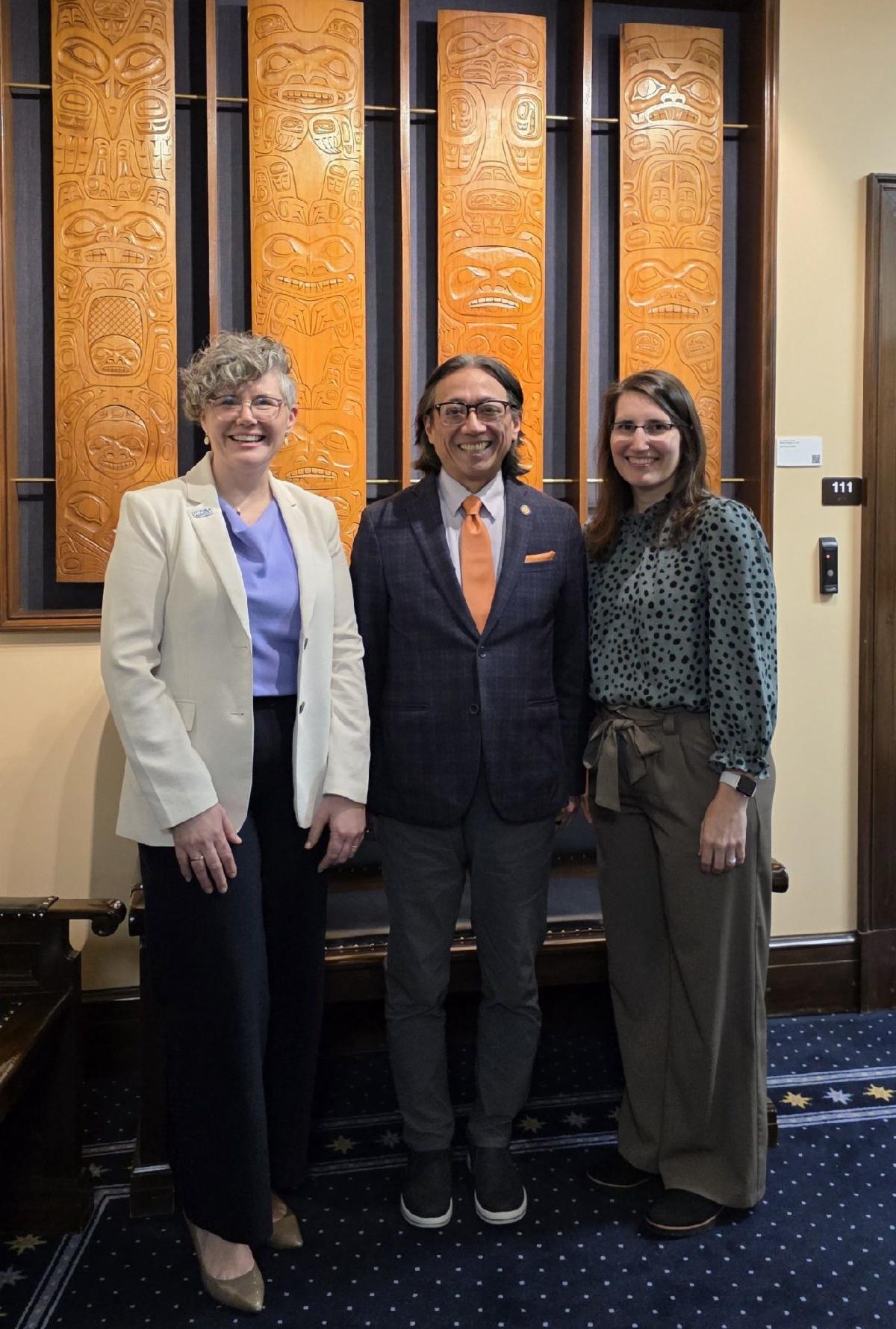
Four members of our Fairbanks North Star Borough School Board came to Juneau this week to advocate for our students, teachers, staff and parents. Tim Doran, Morgan Dullen, Audra Hull and student representative Liam Wade. During their time in Juneau, they testified at the House Education Committee on statewide funding and maintenance concerns. They also met with members of the Interior delegation to address district priorities.
Since winning my first election I have always placed educating our future as the most essential responsibility a legislator should have. Providing resources and quality facilities is paramount to producing the next generation of electricians, laborers, carpenters, engineers, veterinarians, doctors, nurses, military personnel, law enforcement, teachers and more. Shortchanging them does not make Alaska a better place to grow, raise a family and retire. I will always support providing the resources needed to keep our students competitive with their peers in Alaska and around the country.
| | |
My Staff and I are Here for You
As always, I will continue to keep you updated on what I’m working on in Juneau throughout the session. If you have any questions about anything going on in the Capitol or at home, feel free to give me a call or shoot me an email – as always, my staff and I are working for you. We will assist you with the issues important to you and your family.
| | Working Hard for Fairbanks Families, | | |
Senator Scott Kawasaki
Alaska State Senator
Serving the City of Fairbanks, Ft. Wainwright & Badger Road
| | |
As your Senator, I am here to listen and help. Contact me anytime. | | | | | |