|
Dear Neighbors,
The legislature has been busy as we approach the spring recess, at which time some legislators go home to host town hall meetings. The Anchorage Delegation and Mat-Su Delegation will host their annual town hall on March 14th with details forthcoming. Because Rep. Maxine Dibert and Rep. Will Stapp and I hosted a town hall meeting only three weeks ago, my next scheduled trip home will not be until early April – And we will certainly have a lot to talk about!
The war in Iran has caused a sharp rise in oil prices. While this helps ease a state budget, making it easier to balance, it also means that heating oil, electricity, and gasoline are expected to rise sharply, which is very bad for Alaska families. My probate efficiency bill, a museum construction bill, and a bill that sets up a process for school and public library book policy have all been moving recently.
Earlier last week, my Senate State Affairs Committee brought forth the Dunleavy Administration about sending personal, confidential voter information to the White House in violation of state law. An elections reform bill is set for hearings in the House Finance Committee with hopeful passage in time for the 2026 election cycle.
My office is trying to respond to every email, call and letter quickly and I have set up a new system to reach me, post a comment and get an answer promptly. These and many more items are in this edition of the E-newsletter!
| Alaskans Deserve the Freedom to Read | |
On March 2, the Senate Education Committee heard SB238, which my office calls the Freedom to Read Act. This bill would establish a statewide policy for the consideration of library materials for public and school libraries. Included in the policy would be a process to reconsider library material if a patron of the library has an objection to it being included in the collection. This reconsideration process would require the library material to be considered as a whole and if the material is found to have any scientific, artistic, political, or literary value, it will be included in the collection. Libraries are a marketplace of ideas that are free to an entire community. Which means its collection should reflect the diverse patronage it serves.
SB238 would also provide security and protection for librarians and teachers who are simply performing their duty by providing curated materials to the public. I have been working with local librarians and they requested that these protections be added to SB238 due to the increased harassment they have experienced. Lastly, SB238 would create a private right of action for individuals who experience censorship of library materials. This empowers parents to advocate for their children if they are denied access to a piece of literature.
During the bill hearing, several testifiers spoke in support and in opposition. Those supporting the bill, which outnumbered those in opposition, spoke to how a healthy democracy is built on free access to information, the need for this bill in Alaskan communities, their desire to see librarians and teachers receive protection from undeserved prosecutions and how the Freedom to Read is an extension of the First Amendment right of Freedom of Speech.
Parents have the right to monitor their children and what library materials choose but everyone enjoys the right to access curated library materials. As stated previously in this article, library collections serve a diverse range of people, so their collections need to be just as diverse. Not every patron will agree with every viewpoint expressed in a library; that disagreement doesn’t mean the library should restrict access to a controversial viewpoint. Censorship is a slippery slope.
SB238 will be heard again in the Senate Education Committee. If you would like to show your support for this bill, please send an email to Senate.Education@akleg.gov.
| Privacy is a Constitutional Guarantee | |
The legislature had two separate hearings on the Alaska Constitutional Right to Privacy upon learning the Dunleavy Administration released confidential voter information to the Trump Administration. Most states have rejected the request outright and some have even been sued. So far federal courts in Oregon, Michigan and California have ruled that the requests are out of line with federal laws. Only Alaska and Texas have offered up confidential voter information to the White House. Three separate federal judges — in Oregon, California and Michigan — have already ruled that the federal government request is not in compliance with federal law.
During our questioning, neither election officials nor the Alaska Department of Law explained why the state voluntarily complied with the request and signed the memo, or how compliance was allowed under the Alaska Constitution’s right to privacy. If it did, how did they reach their conclusions.
Our committee members strongly believe this is a grave issue of concern for hundreds of thousands of Alaskans, and asked Director Beecher to release the legal advice she received before the Division of Elections turned over its voter list, but she was not willing to do so.
Sen. Gray-Jackson asked Director Beecher whether the Department made a mistake by sharing voter data and signing the MOU allowing the federal government to single out individual Alaskans. The director said she did not believe that the division made a mistake in signing the MOU.
During the hearing, it was revealed that the information transmitted to the Department of Justice went beyond the publicly available voter information requested in August. The December request contained personal information such as birth dates, driver’s license numbers and partial Social Security numbers.
The legal analysis I requested last month called the DOJ’s request “unprecedented” and said the division’s handover would be legal only if the federal government requested the information “in compliance with federal law” and used “the information only for governmental purposes authorized under law.” Legislative attorney Andrew Dunmire also said he was unaware of any federal law that allows the federal government to single out individual voters for removal from voter lists, as the MOU states.
Director Beecher said the DOJ has not yet requested any voters be removed from Alaska’s rolls. Lt. Governor Dahlstrom said in December the state would comply with the MOU only if the federal government’s actions are legal.
At the conclusion of our hearing, former Alaska attorney general Bruce Botelho advised us to continue pursuing the legal advice given to elections officials by the Alaska Department of Law. He also suggested the Legislature consider filing a lawsuit to have the agreement with the Department of Justice declared illegal and require confidential information to be returned.
| Protecting Alaska Water Against PFAS Contamination | |
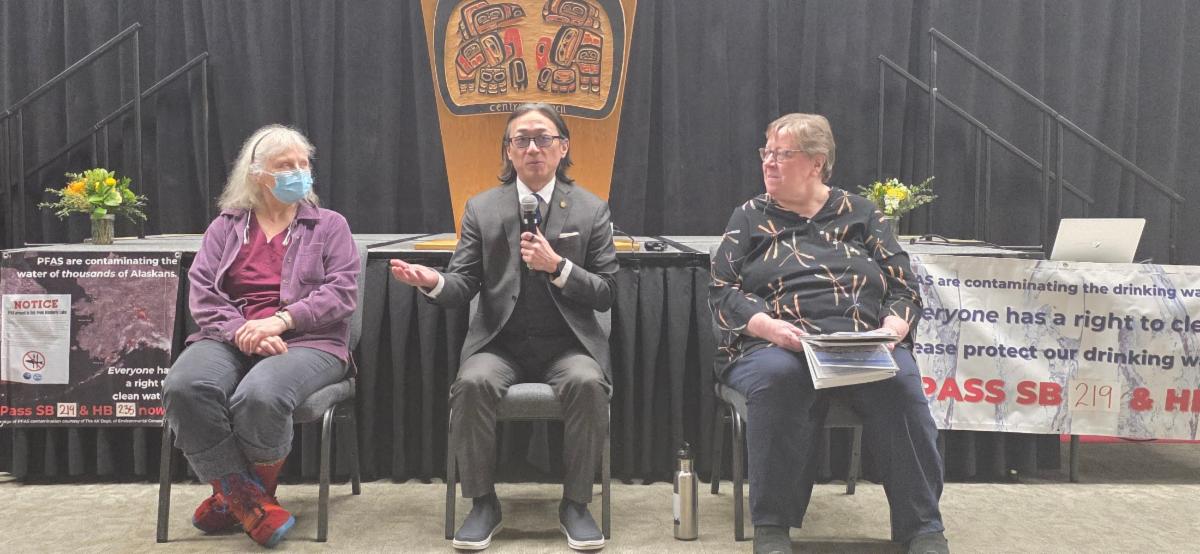
Safeguarding public health is a fundamental responsibility of the state. Many Alaskan communities face growing risks from perfluoroalkyl and polyfluoroalkyl substances (PFAS), or "forever chemicals," which persist in the environment and human bodies for decades. The Department of Environmental Conservation (DEC) has published a statewide contamination map. The risks to Fairbanks residents require immediate action.
To address this issue, I introduced Senate Bill219 to ensure clean water and hold polluters accountable. The health risks of PFAS are well-documented.
These chemicals are linked to:
- Increased risk of cancer
- Developmental issues in infants and children
- Infertility and cardiovascular problems
SB219 is designed to provide both immediate protection and long-term accountability. Mandatory Annual Testing: The bill requires all public water systems to undergo annual testing for PFAS. If contamination levels exceed health-based limits, the state must ensure affected citizens receive safe, clean drinking water immediately. Corporate Accountability: Our communities should not bear the financial burden of a crisis they didn't create. SB219 clarifies liability, ensuring that companies responsible for PFAS releases pay for testing and water replacement. Strict Remediation Standards: Facilities treating PFAS contamination will face rigorous Clean Air Act permitting to prevent environmental impacts during cleanup.
I thank Alaska Community Action on Toxins (ACAT) for their advocacy, research, and commitment to raising PFAS concerns in legislative discussions. We’ll be having our first hearing of SB219 on Thursday, March 12th, in the Senate State Affairs Committee from 3:30-5pm. Together, I know we can protect our water, our health, and our future.
Legislative Teleconference Phone Numbers
All other Callers (844) 586 - 9085
From JNU 586- 9085
From ANC 563 - 9085
| | Calling for Public Testimony on Alaska Budget Priorities | | |
The House Finance Committee will begin providing public testimony on the state operating budget this week. Your opinion on financial priorities like schools, roads, public safety and the PFD matters. Public testimony on Wednesday through Friday of this week. You can testify at the Fairbanks Legislative Information Office at 1292 Sadler Way (the Global USA Building near Home Depot). You can always submit testimony to the House Finance Committee via email at house.finance@akleg.gov or through your member of the House or Senate.
Wednesday from 1:30-3:30pm for Juneau, Sitka, Petersburg, Delta Junction, Dillingham, Glennallen, Valdez, Wrangell, Homer, Ketchikan, Kodiak, Seward, Tok, Off Net
Wednesday from 4:30-6:30pm for ‘Off Net’ meaning all other locations
Thursday from 1:30-3:30pm for Fairbanks, Kenai, Bethel, Cordova, Kotzebue, Nome, Utqiagvik, Off Net
Friday from 1:30-3:30pm for Anchorage, Mat-Su, Off Nets
Legislative Teleconference Phone Numbers
All other Callers 586 - 9085
From JNU 586- 9085
From ANC 563 - 9085
- Please call/arrive 30 min. prior to end of the allotted time or testimony will close early
- Select a spokesperson if you are part of a group with the same message
- All Off Net callers must hang up immediately after testifying to keep lines open
| | |
My Staff and I are Here for You
As always, I will continue to keep you updated on what I’m working on in Juneau throughout the session. If you have any questions about anything going on in the Capitol or at home, feel free to give me a call or shoot me an email – as always, my staff and I are working for you. We will assist you with the issues important to you and your family.
| | Working Hard for Fairbanks Families, | | |
Senator Scott Kawasaki
Alaska State Senator
Serving the City of Fairbanks, Ft. Wainwright & Badger Road
| | |
As your Senator, I am here to listen and help. Contact me anytime. | | | | | |